
We consult and guide you in selecting the ideal LED display based on your requirements. This guide is how we do it: where your viewers stand decides the pixel pitch, the pitch and the site decide the cost, and one quote covers all of it.
What is pixel pitch?
Pixel pitch is the distance in millimetres from the centre of one pixel to the centre of the next. A P2.5 display has 2.5 mm between pixel centres; a P10 has 10 mm. Each pixel combines red, green and blue LEDs and mixes them to make any colour.
A smaller pitch packs more pixels into the same area, so the picture stays sharp from closer up. The effect is steeper than the numbers suggest: halve the pitch and the pixel count goes up four times, because it doubles in both directions.
How far away will your viewers be?
The rule of thumb is about 1 m, or 3.3 ft, of viewing distance for every millimetre of pitch. Closer than that, viewers see individual dots and the dark gaps between them. Further back, the picture only gets cleaner.
Optimal viewing distance, by pixel pitch
- P1033 ft
- P620 ft
- P413 ft
- P310 ft
- P2.58 ft
- P1.96 ft
- P1.55 ft
- P1.24 ft
- P0.93 ft
About 1 m (3.3 ft) for every millimetre of pitch. Closer, the dots show; further back, the picture only gets cleaner.
Measure to the nearest regular viewer
- Measure from the display to where people actually stand or sit, not to the far wall.
- Where the audience is spread across a range, size for the nearest regular viewer, not the closest possible one.
- Count mounting height. A screen fixed high above a shopfront is further from someone on the footpath than the floor plan suggests.
- For a reception wall or a menu board read from 6–10 ft, a fine pitch earns its cost.
- For a hoarding read from a road at 50 ft or more, a coarse pitch is the correct engineering choice, not a compromise.
Which pitch suits which job?
Which pitch is best for which distance
- P1.5 1.5 mmBest for up closefrom about 5 ft
- P2.5 2.5 mmBest for near viewingfrom about 8 ft
- P3 3 mmBest for moderate distancefrom about 10 ft
- P4 4 mmBest for moderate distancefrom about 13 ft
- P5 5 mmBest for mid-to-far viewingfrom about 16 ft
- P6 6 mmBest for far viewingfrom about 20 ft
- P8 8 mmBest for far viewingfrom about 26 ft
- P10 10 mmBest for long-distance viewingfrom about 33 ft
| Where the screen goes | Nearest regular viewer | Pitch |
|---|---|---|
| Lobbies, control rooms, studios | Under 6 ft (2 m) | P0.9–P1.5 |
| Retail flagships, conference rooms | 6–13 ft (2–4 m) | P1.9–P2.5 |
| Menu boards read from a queue | 6–13 ft (2–4 m) | P1.5–P2.5 |
| Auditoriums, large halls, atria | 13 ft (4 m) and beyond | P2.5 |
| Outdoor high-street sites | Across a footpath | P2.5–P4 |
| Outdoor storefronts | Across a street | P4–P6 |
| Highway and arterial-road positions | From the road | P6–P10 |
Most jobs fall within a band, and what you plan to show decides where you land. Large type, logos and video survive a coarse pitch comfortably. Small text, prices, menus and live data push you finer: a capital letter needs about 7 pixels of height, so the smallest one a P10 screen can draw is about 70 mm tall, and on P2.5 about 18 mm.
Indoor or outdoor?
NexGlow supplies indoor screens from P0.9 to P2.5 and outdoor screens from P2.5 to P10, because the distances differ: indoors people walk right up to a screen, while outdoors the nearest viewer is usually across a footpath or a road.
Outdoor panels carry more than pitch: 4,500–7,000 nits of brightness against 600–1,200 indoors, and IP65 sealing on the front face and the rear for Gujarat’s monsoon and dust. A screen behind a shop window that faces the street needs outdoor-rated panels too. Indoor vs outdoor LED displays and how many nits you need cover both choices in full.
How many pixels do you get?
Pitch fixes the resolution: pixels across = display width in mm ÷ pitch in mm, and the same for the height. Screens are built from whole modules, commonly 320 × 160 mm, so a display 2,880 mm (9.45 ft) wide is nine modules across.
| Pitch | Pixels across | Pixels down | Total pixels |
|---|---|---|---|
| P2.5 | 1,152 | 768 | 884,736 |
| P4 | 720 | 480 | 345,600 |
| P6 | 480 | 320 | 153,600 |
| P10 | 288 | 192 | 55,296 |
Even at P2.5, this display has fewer pixels across than Full HD video (1,920 × 1,080), and its shape is 3:2 rather than a TV’s 16:9. Have content made at the screen’s native size and shape.
What decides the cost?
There is no rate card for LED displays: the price depends on your requirement. These are the things that decide it, and pitch matters most, by a distance.
Pixel pitch, above everything else
Every step finer multiplies the LEDs in each square foot, and each pixel needs its own red, green and blue LEDs and the driver ICs to switch them. Pixels per sq ft follow the square of the pitch:
| Pixel pitch | Pixels per sq ft | Compared with P10 |
|---|---|---|
| P10 | about 929 | 1× |
| P6 | about 2,581 | about 2.8× |
| P4 | about 5,806 | about 6.3× |
| P2.5 | about 14,864 | 16× |
| P1.5 | about 41,290 | about 44× |
| P0.9 | about 1.15 lakh | about 123× |
Over-specifying pitch is the overspend we see most often. A P6 already looks continuous from 20 ft, and P2.5 at that distance buys sharpness only someone much closer would notice. Money saved there is better spent where viewers notice it: a larger screen, enough brightness for the site, or front-service cabinets.
Indoor or outdoor rating, and brightness
Outdoor rating carries its own cost: LEDs bright enough to read in daylight, sealed modules and cabinets, and power supplies sized for that output. Pitch for pitch, outdoor costs more per sq ft, which is why an outdoor P2.5 storefront screen costs more than an indoor P1.5 one even though its pitch is coarser.
Size and structure
LED displays are priced on display area, the lit face of the screen, so double the area and the display costs roughly twice as much. Size also sets how much wind the structure must resist, and outdoors that structure is designed for the site.
Service access, control and installation
- Service access: rear-service cabinets need walkable space behind the screen; front-service cabinets can sit flush to a wall.
- Control system: each receiving card drives a limited number of pixels, so a finer pitch or a bigger screen needs more of them. Managing content over Wi-Fi or a cloud platform changes the hardware too.
- Installation: working height, how equipment reaches the site, the distance to a power supply and how cables are run all add work that has to be seen on site to be priced.
Sizes come in whole modules
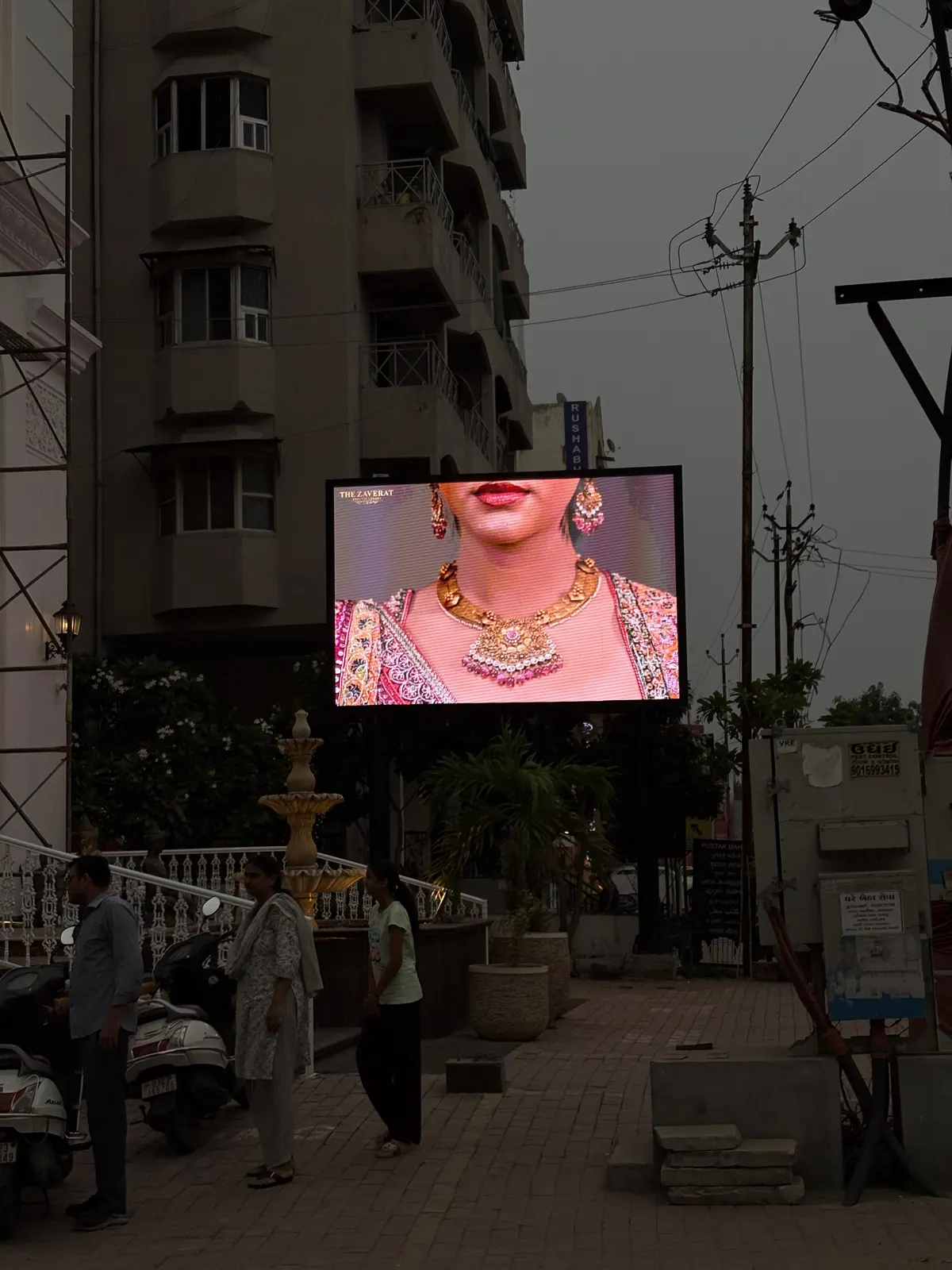
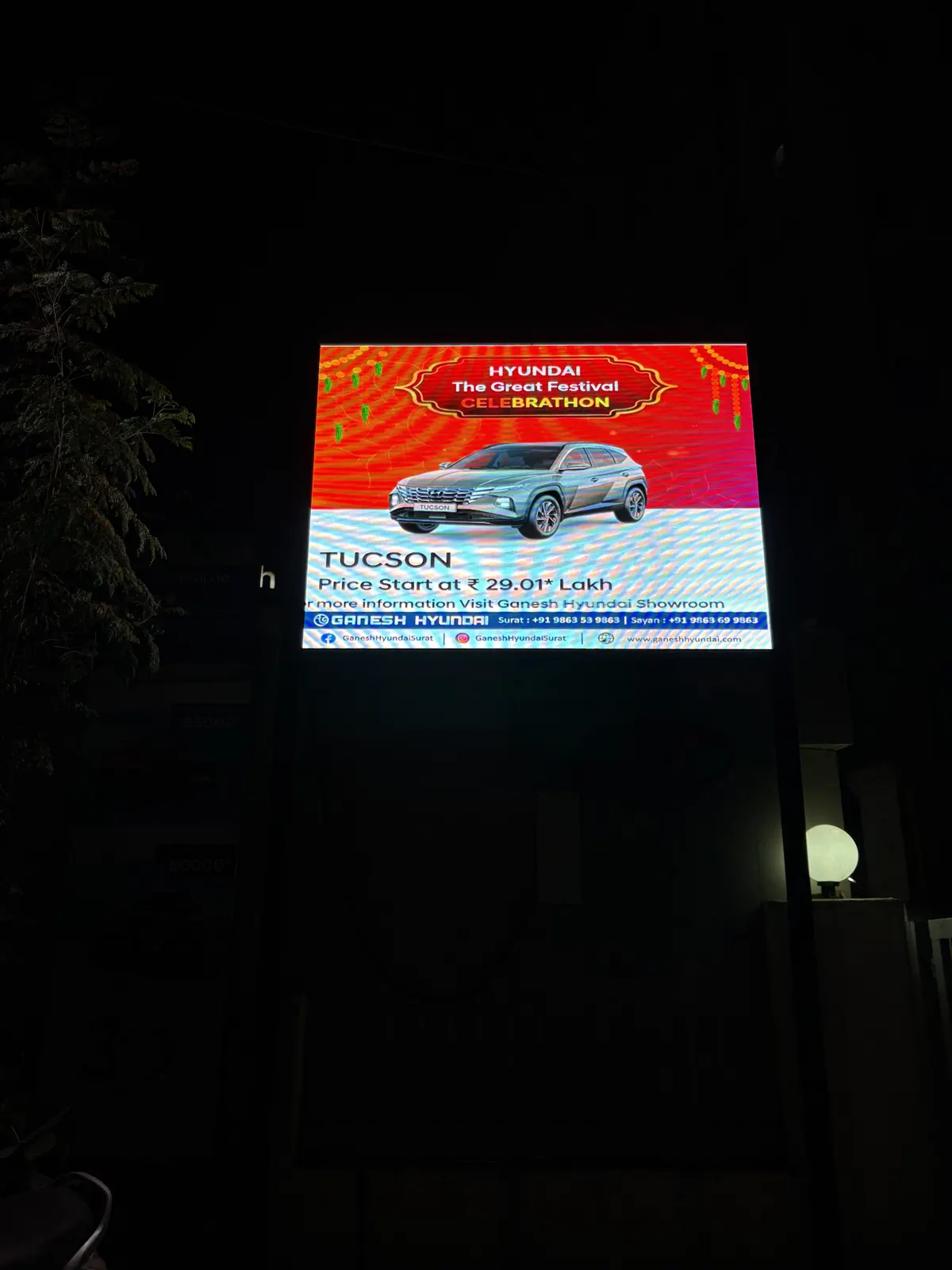
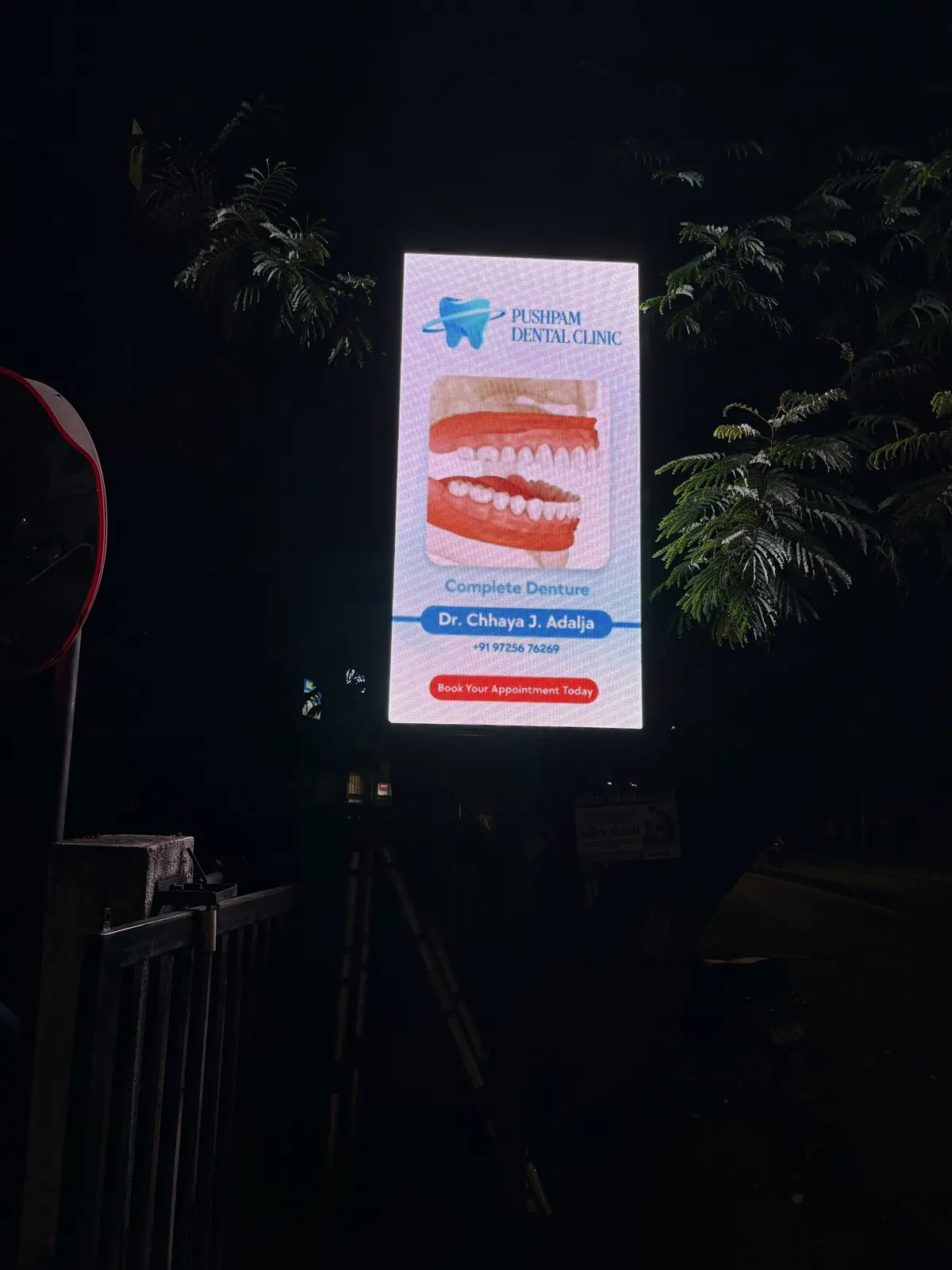
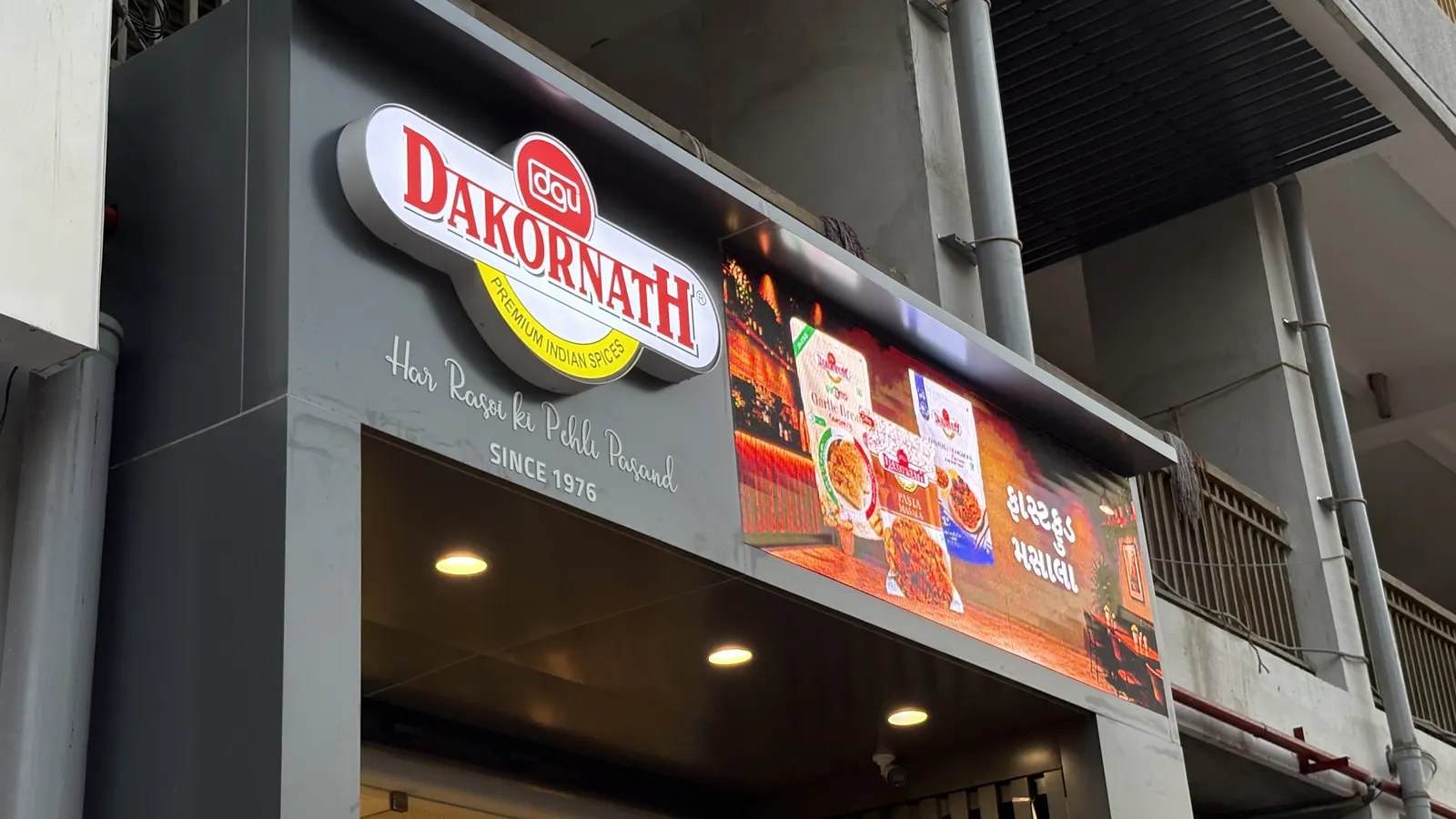
A display is built from whole modules, so its width and height are multiples of the module. That is why sizes on our projects page read as 3.15 ft (960 mm), 6.3 ft (1,920 mm), 9.45 ft (2,880 mm) or 14.7 ft (4,480 mm) rather than round feet. Ask for 10 × 6 ft and the nearest whole-module size might be 9.45 × 6.3 ft.
Real sizes, built from whole modules
What should an LED display quote include?
Everything the screen needs to work on your site. Our quotes are fixed and all-inclusive: display, fabrication and structure, installation and warranty in one figure. We engineer and install structures in-house, so steel and screen are designed together.
A quote well below the others is usually a different job, not a better price. Check what it leaves out or quietly changes:
- A coarser pitch than the other quotes, or no viewing distance stated at all.
- Indoor-grade brightness offered for a shop window or an outdoor position.
- Weaker sealing than the IP65 front and rear we recommend for Gujarat’s monsoon and dust.
- No structure, or a structure with no stated design or wind load.
- No commissioning or testing before handover.
- A shorter warranty, no local service, or spares from a different production batch.
How long does an LED display last?
Premium outdoor LED panels are rated for 100,000+ hours: about 11 years running 24/7, or 30+ years at typical advertising duty cycles. Modules and power supplies can still fail within that time, so the support behind the screen matters as much as the rating:
- A 1 to 3 year warranty on every installation, with an AMC package available.
- On-site technician visits within 48 hours for critical issues.
- Spare modules stocked for the most-deployed panel types.
- Remote diagnostics on cloud-managed panels, so failing modules can be flagged early.
Tell us your requirement
Send these five details, and we will recommend the display that fits and quote it:
- The size you want, or the wall or space dimensions if you aren’t sure.
- The location, and how the screen will be mounted: wall, pole, roof or behind glass.
- The viewing distance: where your nearest regular viewers stand or pass.
- Indoor or outdoor, including in-between spots such as a shop window or a covered walkway.
- What you will show: video, a menu, offers, text or live information.
Send them through our contact page and you will have a recommendation and a fixed, all-inclusive quote.
Questions buyers ask
What pixel pitch do I need for an LED screen?
Choose it from the distance of your nearest regular viewer: about 1 m (3.3 ft) for every millimetre of pitch. P10 looks continuous from about 33 ft, P6 from 20 ft, P4 from 13 ft, P2.5 from 8 ft and P1.5 from 5 ft. Small text such as prices or a menu pushes you to a finer pitch for the same distance.
Is a smaller pixel pitch always better?
No. A smaller pixel pitch only looks sharper to viewers close enough to see the difference. Well beyond a pitch’s viewing distance, a finer pitch adds cost, because the LED count rises steeply, without adding detail a viewer can perceive.
What is the difference between P4 and P10?
P4 has 4 mm between pixel centres and P10 has 10 mm, so P4 packs 6.25 times as many pixels into the same area. A P4 display looks continuous from about 13 ft; a P10 needs about 33 ft. On a screen 2,880 mm (9.45 ft) wide, P4 gives 720 pixels across and P10 gives 288.
What pixel pitch do I need for a shop display?
It depends on where your viewers stand. Street-facing screens suit P2.5–P4 when read from across a footpath, P4–P6 from across a street, and P6–P10 for highway and arterial-road positions. Inside the shop, screens viewed from 6–13 ft suit P1.9–P2.5. Small text such as prices pushes you to the finer end of each band.
What is the price of an LED display in India?
It depends on your requirement. LED displays are priced on display area, and the cost per sq ft rises with finer pixel pitch, outdoor rating, higher brightness and more complex installations; outdoor jobs also need a structure. NexGlow quotes each job as one fixed, all-inclusive price once it knows the size, location, viewing distance and use.
Why does an indoor LED screen cost more per sq ft than an outdoor one?
Indoor screens are viewed from close up, so they use much finer pitches, and pixels per sq ft follow the square of the pitch: about 929 at P10 against about 41,290 at P1.5. Pitch for pitch, outdoor actually costs more, because of brightness and weather sealing.
Does an LED display quote include installation and the structure?
A NexGlow quote does. On outdoor jobs, structural fabrication such as a pole, a facade frame or a rooftop mount depends on the site, so it is designed with the screen. The quote is fixed and all-inclusive: display, fabrication and structure, installation and warranty in one figure.
How do I work out the resolution of an LED screen?
Divide the display width in millimetres by the pixel pitch to get pixels across, and do the same with the height for pixels down. A 2,880 × 1,920 mm (9.45 × 6.3 ft) screen at P2.5 is 1,152 × 768 pixels; at P10 it is 288 × 192. Have content designed at that native size rather than at a TV resolution.
How long does an LED display last?
Premium outdoor LED panels are rated for 100,000+ hours, about 11 years running 24/7 or 30+ years at typical advertising duty cycles. Modules and power supplies can fail sooner, so support matters: NexGlow gives a 1 to 3 year warranty with an AMC package available, on-site technician visits within 48 hours for critical issues, and stocked spare modules for the most-deployed panel types.
Working out a specification?
Send us the wall or the space, how far away people will be and what you need on screen. You get a fixed, all-inclusive quote.
Request a Quote- What to ask for in an LED display quoteTwo quotes for the same wall can differ enormously and both be honest. Usually they are not quoting the same scope.
- LED display brightness: how many nits you needAn indoor screen and an outdoor hoarding differ by roughly an order of magnitude in brightness. Getting it wrong is expensive in both directions.