
Every LED display is built from modules, and modules eventually fail. What decides how much that costs you over ten years is not the failure rate. It is how somebody reaches the failed module.
That reach is decided at the structure stage, and it is expensive to change once the steel is up. It is also the question most quotes leave out, so it is worth settling yourself before you sign.
Why does service access decide the ten-year cost?
An LED display is a grid of cabinets. Each cabinet holds a set of modules, the tiles of LEDs you actually see, plus the power supplies and the receiving card that drive them. Over the years some of those parts will need replacing: a module that goes dark, a power supply that fails, a cable that works loose.
The parts themselves are rarely the expensive bit. The cost is in getting a technician to them. If the failed module can be reached from where the technician stands, the repair is a short visit. If it cannot, the same repair needs scaffold or a lift, which costs more than the module and takes longer to arrange, while a dark patch sits on your screen.
A display is also a long-term asset. Premium outdoor LED panels are rated for 100,000+ hours: about 11 years at 24/7, or 30+ years at typical advertising duty cycles. The access route you choose now sets the price of every repair across that life.
Rear service: when there is room behind the display
A rear-service cabinet is opened from behind. The technician opens the cabinet’s rear door, releases the failed module from inside and fits a new one, with the power supplies, receiving card and cabling all within reach.
That requires walkable space behind the display: a maintenance corridor, a catwalk, or scaffold. Where that space already exists, rear service is a perfectly good arrangement and often cheaper up front, partly because the cabinet does not need the hardware that lets modules release from the face.
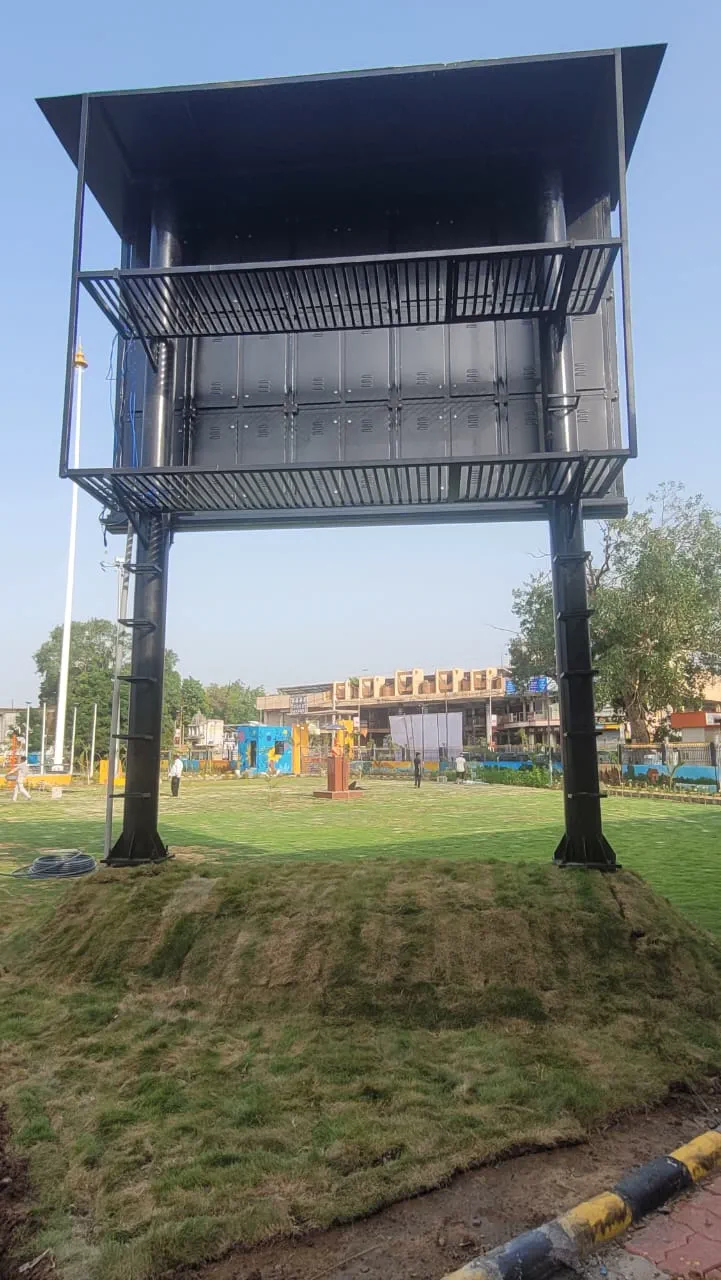
Rear service suits sites where the structure already provides that space: a pole-mounted billboard with a catwalk built into the steel, a rooftop frame, or a wall with a service room behind it. The catwalk has to be designed in from the start, with a safe way up to it, railings, and room for a person carrying a module.
The back of an outdoor cabinet faces the weather too. For outdoor LED screens in Gujarat’s monsoon and dust, NexGlow recommends IP65 on the front face and the rear. A rear door that is opened for every repair needs seals that stay sound.
Front service: when the display sits against a wall
A front-service cabinet lets a single module come out from the face of the display. The modules are held magnetically, so the technician lifts one off with a magnetic tool, unplugs it and fits the replacement. In most front-service designs the power supplies and receiving card are reached through the opening the module leaves.
Nothing is needed behind the display, which means it can sit flush against a wall, be set into a facade, or fill a recess. A failed module is swapped from the front. On a display mounted high that still means a ladder or a platform, but not scaffold behind a wall that has no room for it.
The difference shows up the first time something fails on a wall-mounted screen with no rear access. A module swap that should take minutes turns into a scaffold booking.
Front service has its own demands. It usually costs more up front, and all the work happens on the face of the display, so a module has to be reseated level with its neighbours or it shows as a line in the image. That is a job for a trained technician with the right tool.
Where the technician has to stand
Front service vs rear service at a glance
| Rear service | Front service | |
|---|---|---|
| Space behind the display | Walkable space: a corridor, catwalk or scaffold | None; the display can sit flush against a wall |
| Mounting | Pole structures and frames with a catwalk, or a wall with a service room behind | Flat on a wall, set into a facade or sign, or in a recess |
| Module swap | From behind, through the cabinet’s rear door | From the face, lifted out with a magnetic tool |
| Power supplies and receiving card | Reached directly from behind | Usually reached through the opening a module leaves |
| Typical sites | Pole-mounted billboards, hoardings, rooftop frames | Facades, storefronts, indoor walls, displays set into signs |
| Up-front cost | Often lower | Often higher |
| What to watch | The access route has to be built, reachable and kept safe | Modules have to be reseated level by a trained technician |
Which suits a facade, and which suits a billboard?
The site usually answers the question. Start with what is behind the display position: a solid wall, a void, a service room, or open air.
Wall-mounted facades
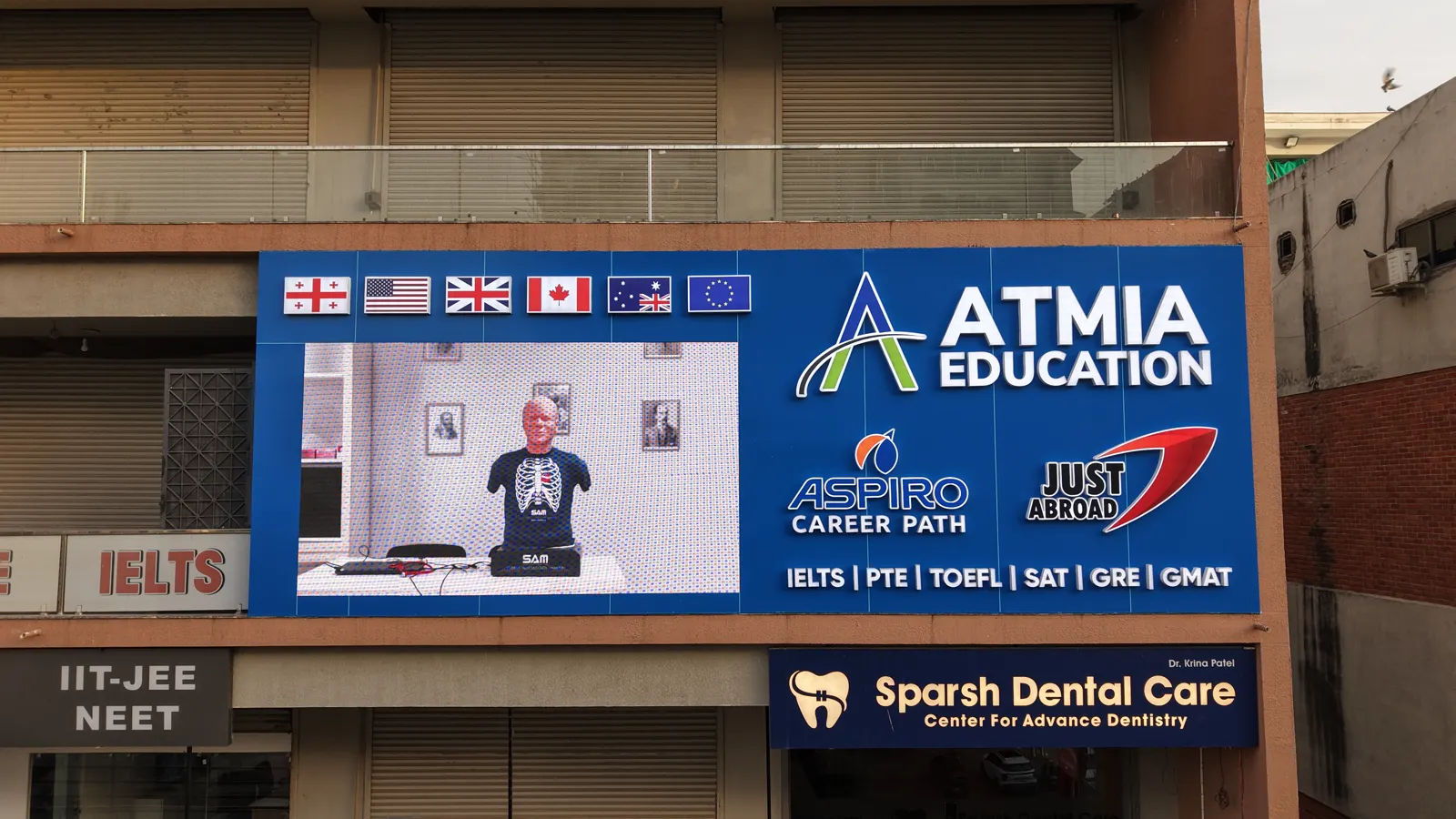
A display fixed flat to a building has nothing walkable behind it unless the building provides it. Facade displays such as Shree Janmangal Jewellers’ 9.45 × 8.4 ft facade display in Anand, or Atmia Education’s 13.65 × 7.88 ft LED wall set into a 31 × 11.34 ft facade sign on Anand–Vidyanagar Road, are the kind of sites where this has to be answered at the design stage.
For any facade, the test is where the technician will stand when a module fails. If the honest answer is “in front of it”, the cabinets need to open from the front. If the display is set into a larger sign, ask if the sign frame leaves a walkable void behind the cabinets, or if every repair will come from the face.
Billboards and hoardings
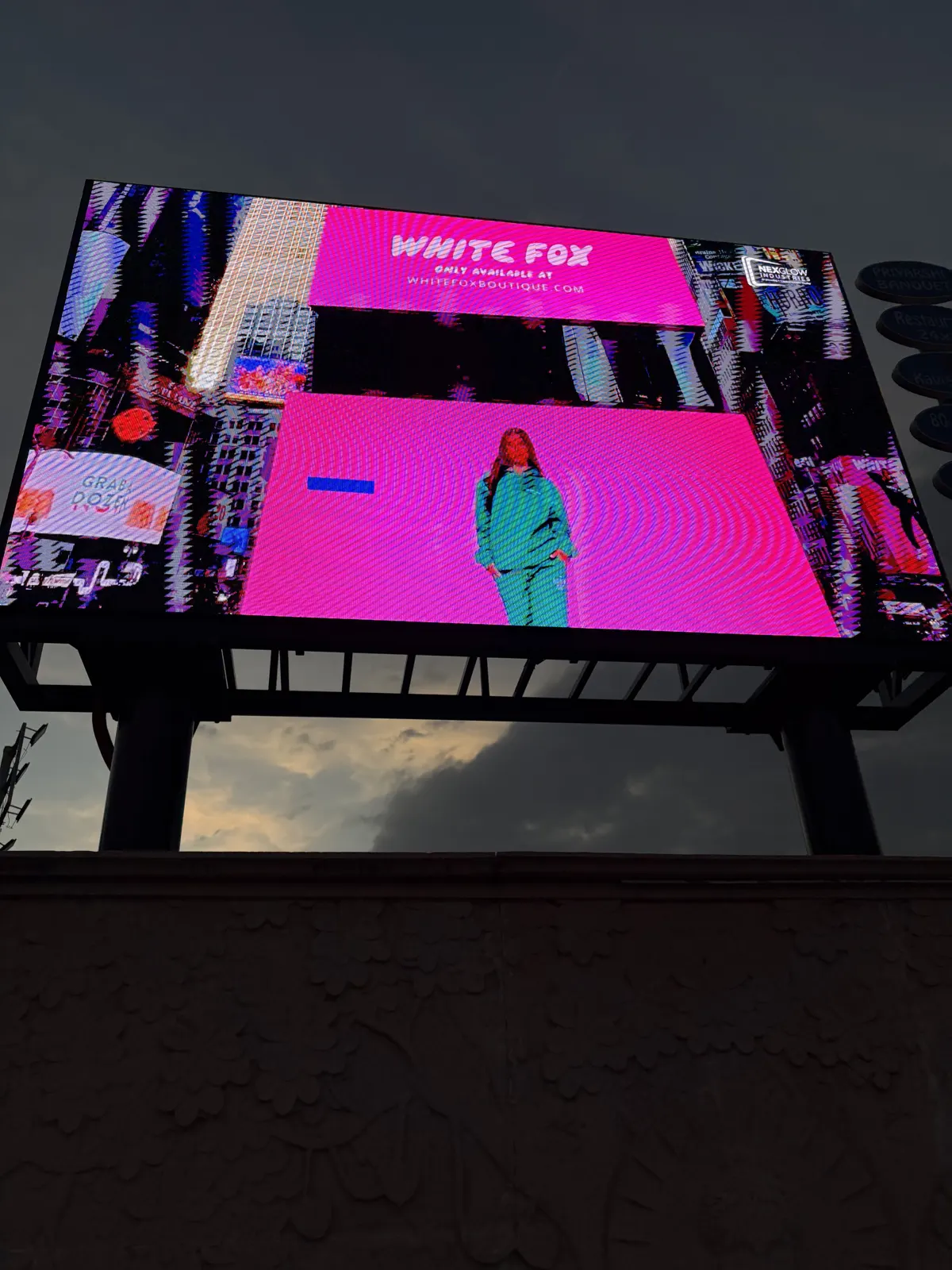
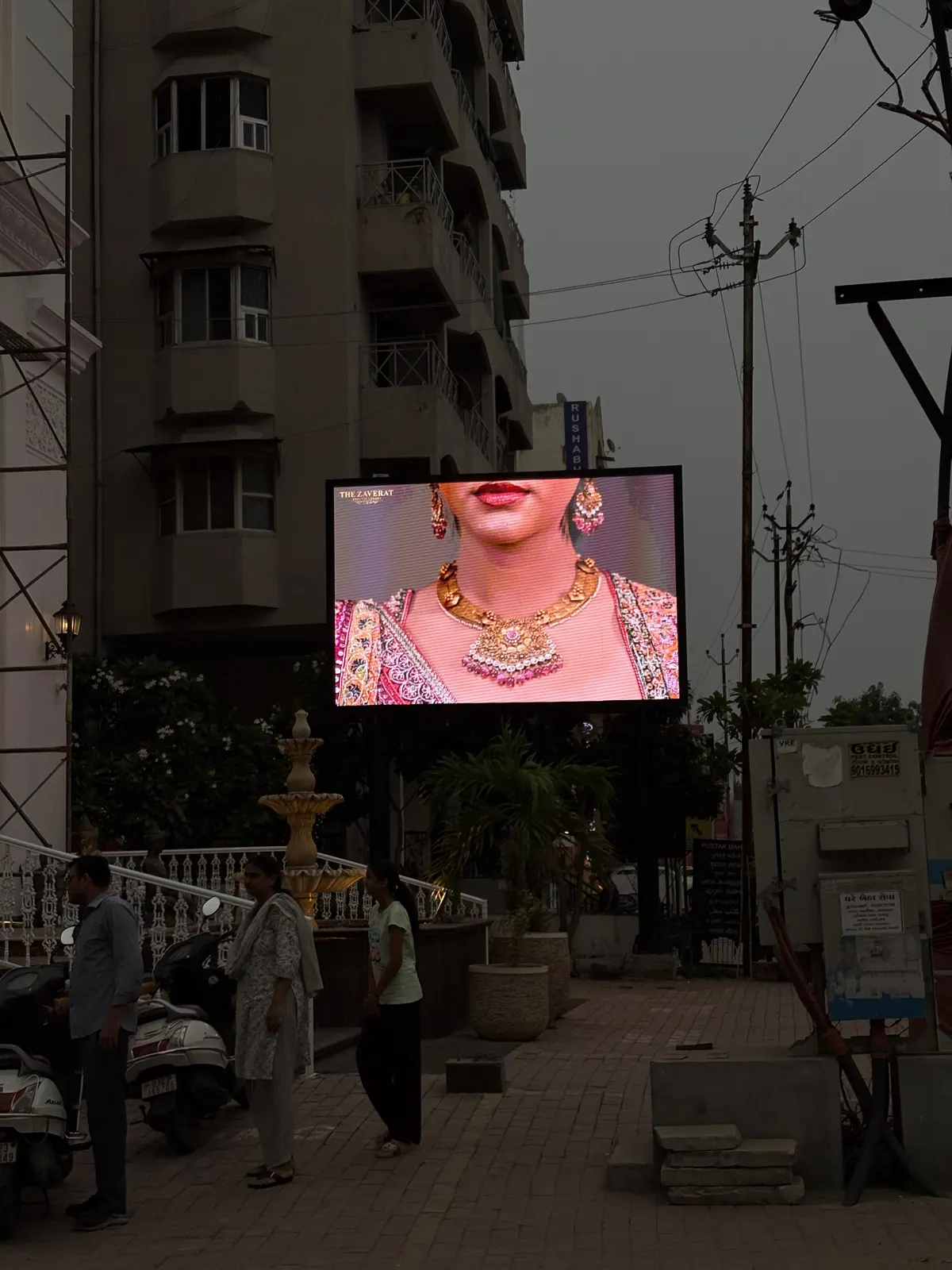
A billboard on poles is open at the back, so a catwalk can be built into the structure. Billboard-format sites such as Manish Aura Grand’s 14.7 × 9.45 ft pole-mounted billboard at its entry gate on the Vadodara Bypass, The Zaverat’s 14.7 × 9.45 ft billboard in Anand, and Petlad Nagar Palika’s 15 × 10 ft display with its service catwalks all raise the same question: how does a technician reach the cabinets safely at height?
A catwalk makes either type workable: behind the cabinets for rear service, in front of them for front service. Without one, every repair means bringing a lift or platform to the display, at height and often beside a road. On outdoor advertising sites, what does not work is leaving the decision until the poles are in the ground.
Facade and billboard sites
Why the structure has to be designed around service access
Service access is not an option you tick at the end. It is decided when the structure is designed, because the steel determines whether there is a catwalk, how far the cabinets stand off the wall, how the cables are routed and where a technician can safely stand. Changing service type after fabrication usually means changing the steel.
Petlad Nagar Palika’s display shows what that planning involves. The 15 × 10 ft screen stands on a pole structure with a 10 mm MS base plate, 12-inch vertical support poles, underground conduit for the cabling, and service catwalks, and it was tested for 48 hours continuously at full brightness before handover. The Petlad case study covers the build.
Design for wind load from the start. A 15 × 10 ft face is 150 sq ft of flat surface for the wind to push against, and a catwalk adds weight and surface of its own. The poles, base plate and foundation have to be sized for the wind at that site, and the quote should say who designs the structure and who certifies it.
For outdoor jobs, NexGlow engineers and installs structures in-house, and structural fabrication is part of the quote. That keeps the service route, the steel and the display in one design instead of three.
Who replaces a failed module, and how fast?
Ask who carries out module replacement and what the response time is. A fast response only helps if the technician can reach the module on arrival; a visit to a display with no access route becomes a visit plus a scaffold booking.
NexGlow’s support works like this:
- A 1 to 3 year warranty on every installation, with an AMC package available, plus maintenance support and on-call service from the Vadodara team.
- On-site technician visits within 48 hours for critical issues.
- Stocked spare modules for the most-deployed panel types.
- Remote diagnostics on cloud-managed panels, so failing modules can be flagged early.
Spares matter more than they look. LEDs are sorted into colour bins when they are made, and the bins drift between production batches, so a replacement module from a different batch can be visibly different on the wall. Ask for spares from the same batch as your display.
Settle these before the steel goes up
- Check what is behind the display position: a solid wall, a void, a service room or open air.
- Decide service access before the mounting structure is designed, not after.
- For any display fixed flat to a wall, assume you need front service unless someone can show you the access route.
- For a pole-mounted hoarding, confirm whether the structure includes a service catwalk, which side it is on, and how it is reached.
- Ask who designs the structure, to what wind load, and who certifies it.
- Agree the IP rating for the rear of the cabinets as well as the front.
- Ask how power and data cables reach the display and how they are protected.
- Ask who carries out module replacement, the response time, and whether spares from the same batch are held.
- Get the service type written into the quote. What to ask for in an LED display quote covers the rest of the scope.
Questions buyers ask
What is the difference between a front-service and a rear-service LED display?
A rear-service LED display is maintained from behind: a technician opens each cabinet’s rear door, so it needs walkable space such as a corridor, catwalk or scaffold. A front-service display is maintained from the face: modules are lifted out with a magnetic tool, so the display can sit flush against a wall with nothing behind it.
Is a front-service LED display more expensive?
Usually, up front. Front-service cabinets need modules that release from the face, so they often cost more to buy. Rear service is often cheaper at the start, but only works where walkable space behind the display already exists or is built into the structure. Over ten years, the cheaper option is the one a technician can reach without hiring scaffold.
Can a rear-service LED screen be mounted flat on a wall?
Only if there is a way to reach the back, such as a service room or a walkable void behind the wall. Fixed flat against a solid wall, a rear-service cabinet cannot be opened without taking the display down. For any wall-mounted display, assume you need front service unless the supplier can show you the access route.
Which is better for an outdoor LED billboard on poles?
Either can work. A pole-mounted billboard is open at the back, so a catwalk can be built into the structure for rear service; front service on a billboard means reaching the face at height from a catwalk, lift or platform. Decide when the structure is designed, because the catwalk, its access and the wind load all depend on it.
How quickly can a failed LED module be replaced?
The swap itself is quick once a technician can reach the module; what takes time is access. NexGlow sends an on-site technician within 48 hours for critical issues and stocks spare modules for its most-deployed panel types. On a display with no access route, the repair can also need scaffold or a lift, which takes longer to arrange.
What IP rating should the back of an outdoor LED cabinet have?
For Gujarat’s monsoon and dust, NexGlow recommends IP65 on the front face and the rear. A pole-mounted display can face the weather on both sides, so confirm the rear rating in the quote rather than assuming it matches the front.
Working out a specification?
Send us the wall or the space, how far away people will be and what you need on screen. You get a fixed, all-inclusive quote.
Request a Quote- What to ask for in an LED display quoteTwo quotes for the same wall can differ enormously and both be honest. Usually they are not quoting the same scope.
- LED screen guide: how to choose the right displayWe consult and guide you in selecting the ideal LED display for your requirement: pixel pitch by viewing distance, which pitch suits which job, and what decides the cost.