
On a spec sheet, indoor and outdoor LED displays look alike: modules, cabinets, a pitch and a brightness figure. They are built for very different conditions, and the costly mistakes tend to happen at the boundary, where a screen sits behind a shop window, under a canopy or in an open-fronted showroom.
This guide compares the two on brightness, sealing, heat, pitch, structure and cost, then deals with the in-between sites and the question of indoor screens outdoors.
Indoor vs outdoor LED displays at a glance
| What changes | Indoor | Outdoor |
|---|---|---|
| Brightness | 600–1,200 nits | 4,500–7,000 nits; 5,500–7,000 for direct sun, 3,500–4,500 for shade or cover |
| Weather sealing | Not sealed against rain or dust; built for dry rooms | IP65 front and rear |
| Pixel pitch | P0.9–P2.5 | P2.5–P10 |
| Typical viewing distance | Under 2 m (P0.9–P1.5); 2 m and beyond (P1.8–P2.5) | Across a footpath (P2.5–P4) to arterial roads and highways (P6–P10) |
| Mounting | Wall, frame or stand; no wind load | Steel structure designed for the site and its wind load |
| Typical uses | Menu boards, retail displays, lobbies, conference rooms, auditoriums | Storefronts, facades, billboards, entry gates, highway hoardings |
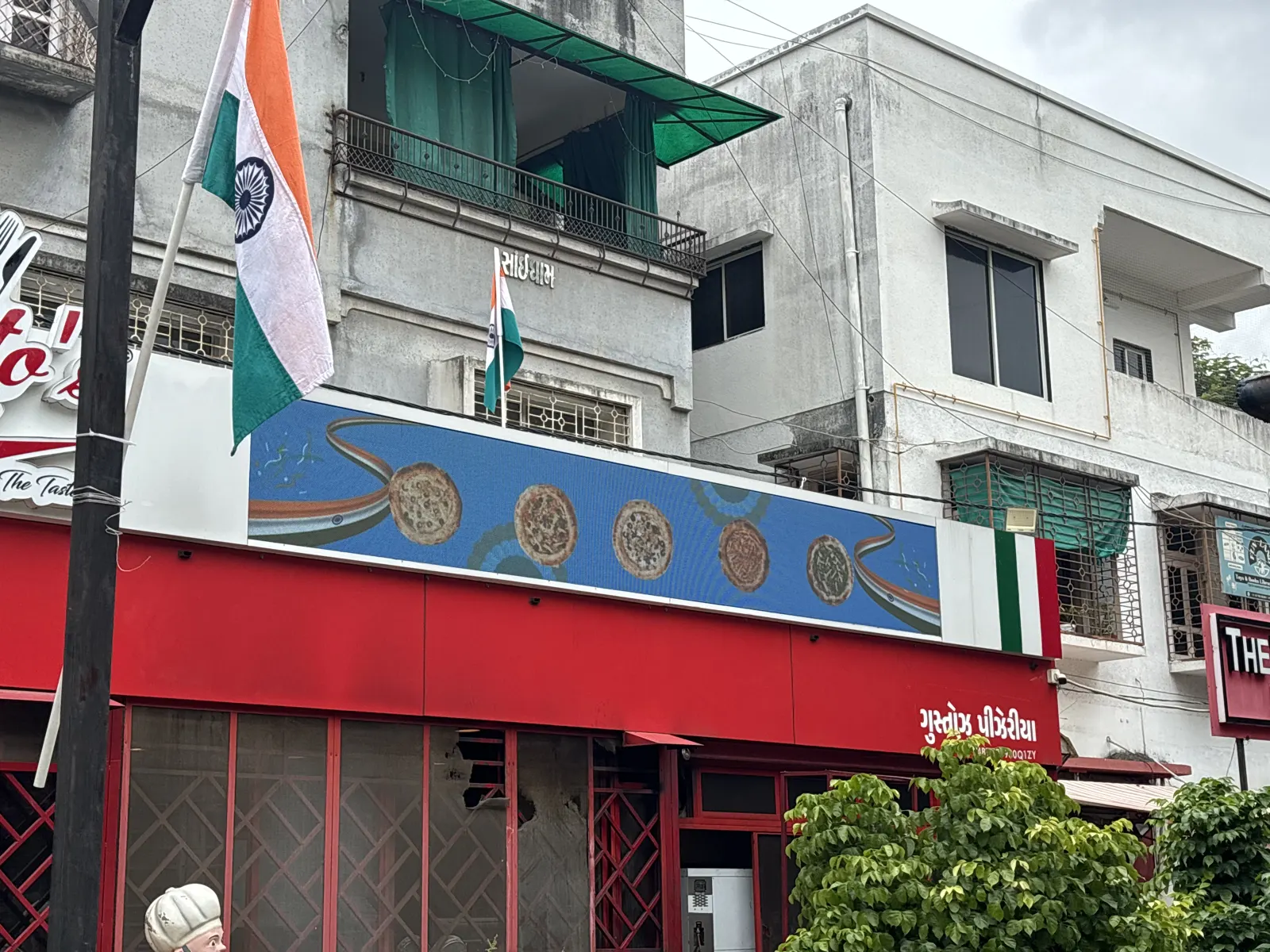
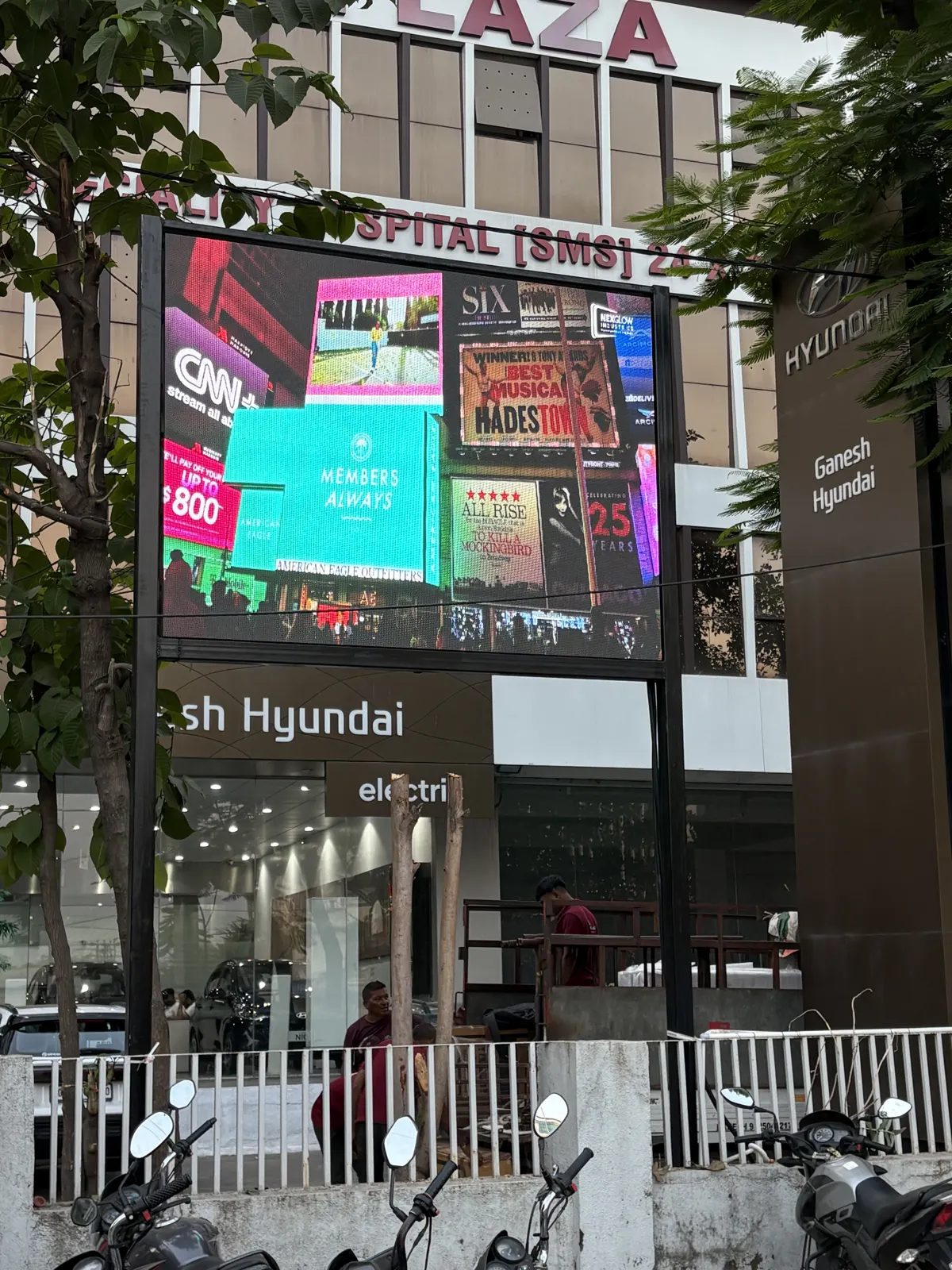
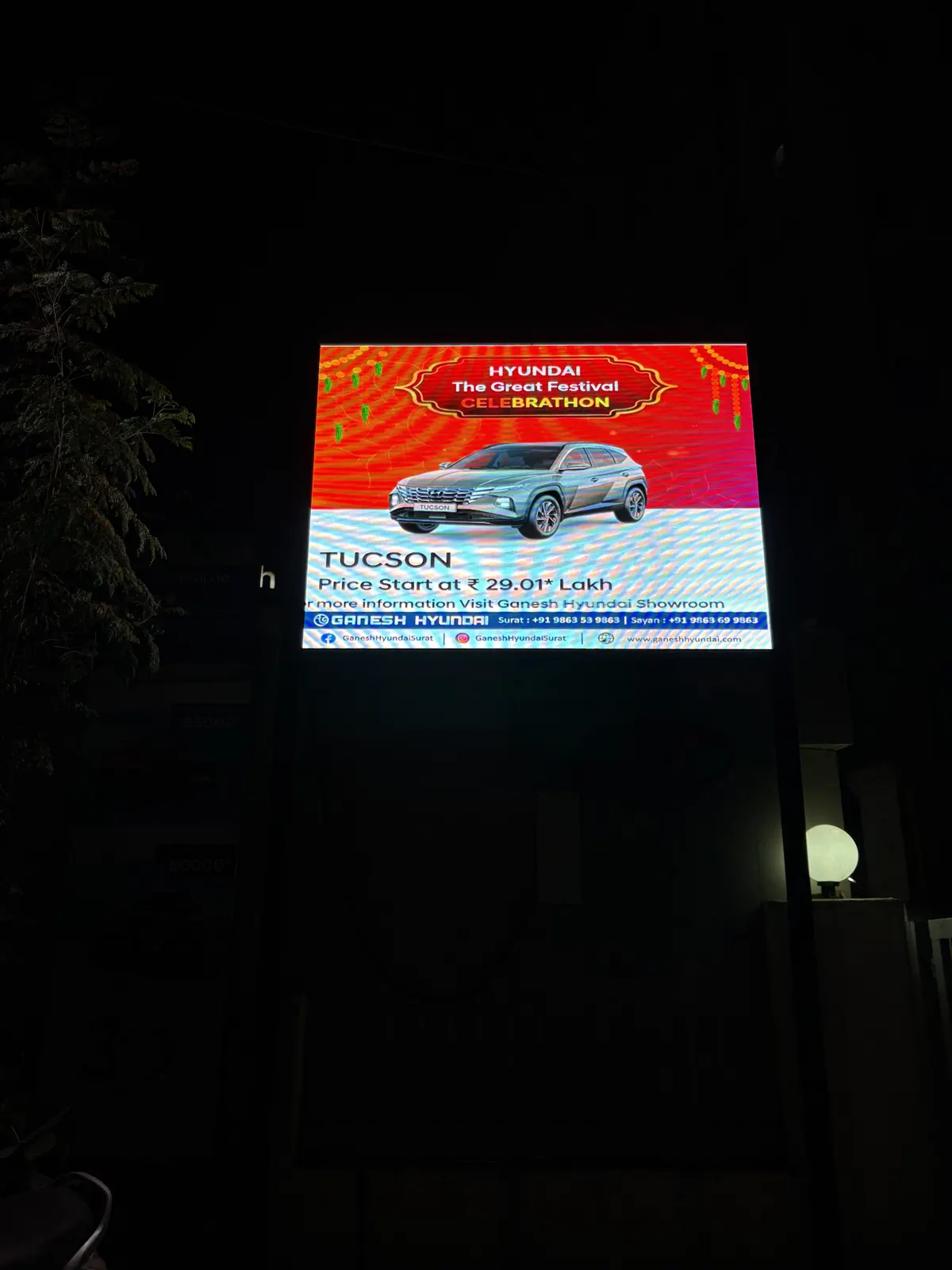
Most of our own installations are outdoor. Gusto’s Pizzeria at Ellora Park has an 18.89 × 2.62 ft storefront strip, Dakornath Masala at Darbar Chowkdi a 7.35 × 2.62 ft storefront display, and Ganesh Hyundai’s showrooms at Maneja and Gotri each have an 8.4 × 6.3 ft outdoor display. Indoors the technology is the same; the specification is not.
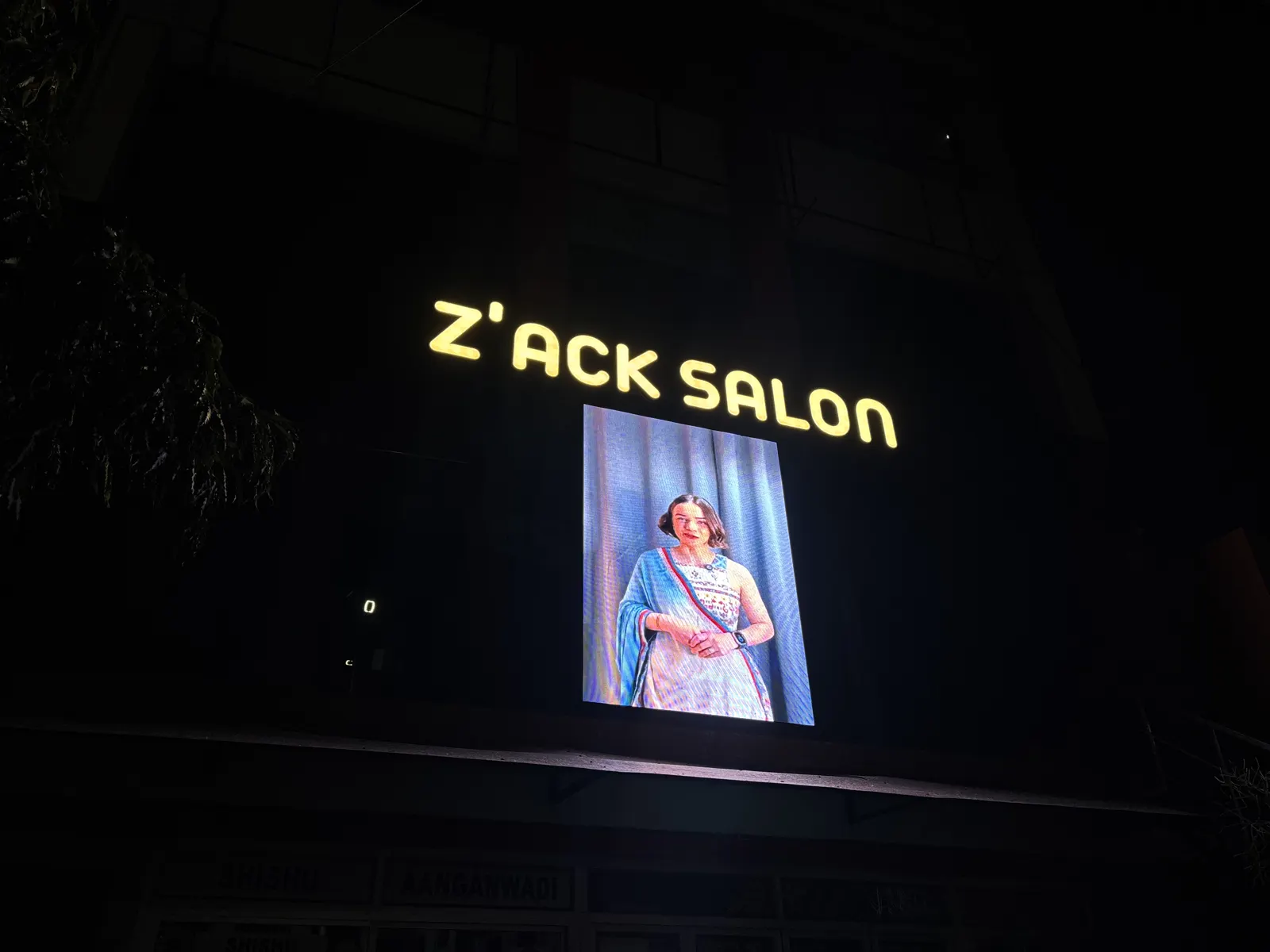
Outdoor screens from our projects
How bright does an indoor or outdoor LED display need to be?
Brightness is measured in nits: candelas per square metre of screen. An indoor screen competes with ceiling lights, so 600–1,200 nits is plenty, and indoor screens usually run well below their maximum. An outdoor screen competes with daylight. In direct sun it needs 5,500–7,000 nits to stay readable in peak Indian afternoon glare; in shade or under a covered walkway, 3,500–4,500 is enough.
How bright a display needs to be, by setting
- IndoorLobbies, showrooms, menu boards600–1,200
- Outdoor, shadedCovered walkways, shaded fronts3,500–4,500
- Outdoor, direct sunSun-facing fronts and hoardings5,500–7,000
- NexGlow outdoor panelsScheduled down after dark4,500–7,000
Brightness in nits (cd/m²)
Too much brightness is a fault as well. Indoors, an over-bright screen is unpleasant to stand near, burns power and shortens LED life. Outdoors, brightness can be scheduled down after dark, so the screen isn’t glaring at night.
When you compare quotes, confirm the brightness figure is sustained, not a peak, and that it applies to the exact panel being offered. Our explainer on LED brightness in nits goes deeper.
Sunlight brings heat as well as glare
Sun on the face of a screen washes out contrast and heats the cabinet. LEDs lose brightness and age faster as they get hotter, so outdoor cabinets are designed to shed heat, and outdoor modules commonly carry louvred masks that shade the LEDs to hold contrast in daylight.
Orientation matters: which way the face points decides how many hours of direct sun it takes. Running at full brightness all day adds heat of its own, which is one more reason to let brightness follow the light rather than sit at maximum.
What IP rating does an outdoor LED display need?
An IP rating has two digits: the first for protection against solids such as dust, the second against water. In plain terms:
- IP65: dust-tight, and protected against jets of water from any direction. This is the level for a face that takes wind-driven monsoon rain.
For Gujarat’s monsoon and dust, we recommend IP65 on the front face and the rear, because weather and salt air reach the back of a cabinet as well as its face. Cable entries and connections have to be sealed on site as well; an IP65 cabinet fed through an unsealed cable entry won’t behave like one.
Indoor screens aren’t sealed against water or dust. That is fine in a dry room, and a fault waiting to happen anywhere rain, dust or humidity can reach the modules and power supplies.
Why indoor screens use a finer pixel pitch
Indoor pitches run from P0.9 to P2.5, outdoor from P2.5 to P10, and the reason is distance. The minimum comfortable viewing distance in metres is roughly the pitch in millimetres. Indoors, people stand close: a lobby wall or control room is read from under 2 m, a menu board from a queue at 2–4 m, an auditorium screen from 4–8 m.
Outdoor audiences are further away. P2.5–P4 suits a high-street site read from across a footpath, P4–P6 a storefront read from across a street, and P6–P10 a highway or arterial-road position. A finer pitch outdoors buys detail nobody is close enough to see. The two ranges overlap between P2.5 and P6, which is exactly where storefront screens sit.
Where each pixel pitch starts to look like a picture
- P1.5Under 2 m: lobbies, control rooms, close menu boardsfrom ~1.5 m
- P2.52 m and beyond: retail interiors, conference rooms, menu boards, hallsfrom ~2.5 m
- P44–8 m: high-street frontsfrom ~4 m
- P68 m+: storefronts read from across a streetfrom ~6 m
- P10Highway and arterial-road sitesfrom ~10 m
Minimum comfortable viewing distancePixels visibleReads as a continuous image
Content shifts the answer at the margin, because pixels across = width ÷ pitch. A 3.2 m (10.5 ft) wide screen has 1,280 pixels across at P2.5 but only 320 at P10, so dense text and small numbers push you finer, while large type and brand imagery survive a coarser pitch. Our LED screen guide works it through.
Shop windows, covered walkways and semi-outdoor sites
Plenty of screens are neither clearly indoor nor clearly outdoor. Judge each by what actually reaches the screen: daylight, rain, dust and heat.
Behind a shop window
A screen behind glass stays dry, but it faces the street’s daylight. Indoor panels at 600–1,200 nits wash out behind glass in direct sun, so storefront and window-facing screens should use outdoor-rated panels. Glass also reflects, and a sunny window adds heat as well as glare.
Covered walkways and canopies
A roof keeps direct sun off the face, so shaded positions and covered walkways can use 3,500–4,500 nits rather than 5,500–7,000. It doesn’t keep out dust, humidity or wind-driven monsoon rain, so outdoor sealing still applies: IP65 front and rear.
Semi-outdoor sites
“Semi-outdoor” covers the rest: an open-fronted showroom, a hotel porch, a drive-through window. Treat them as outdoor for sealing, and size brightness to the light that falls on the screen face, not to the roof above it. If afternoon sun reaches the face, specify for direct sun.
Structure and wind load outdoors
Indoors, a screen hangs on a wall or a frame. Outdoors it behaves like a sail: the structure has to carry the screen’s weight and resist wind pressure across its whole face, through every monsoon, on that particular site.
Ask what wind load a structure is designed for, and who designed it. In India, wind loads on structures are set out in IS 875 (Part 3). We engineer and install structures in-house, and on outdoor jobs the structure is part of the quote. Power belongs in the same conversation: an outdoor screen needs a weatherproof, properly earthed supply, with cables protected from water on their way to it.
The Petlad Nagar Palika display shows what that means at scale: a 15 × 10 ft large-format screen on a pole structure with a 10 mm MS base plate, 12-inch vertical support poles, underground conduit cabling and service catwalks, run for 48 hours continuously at full brightness before handover.
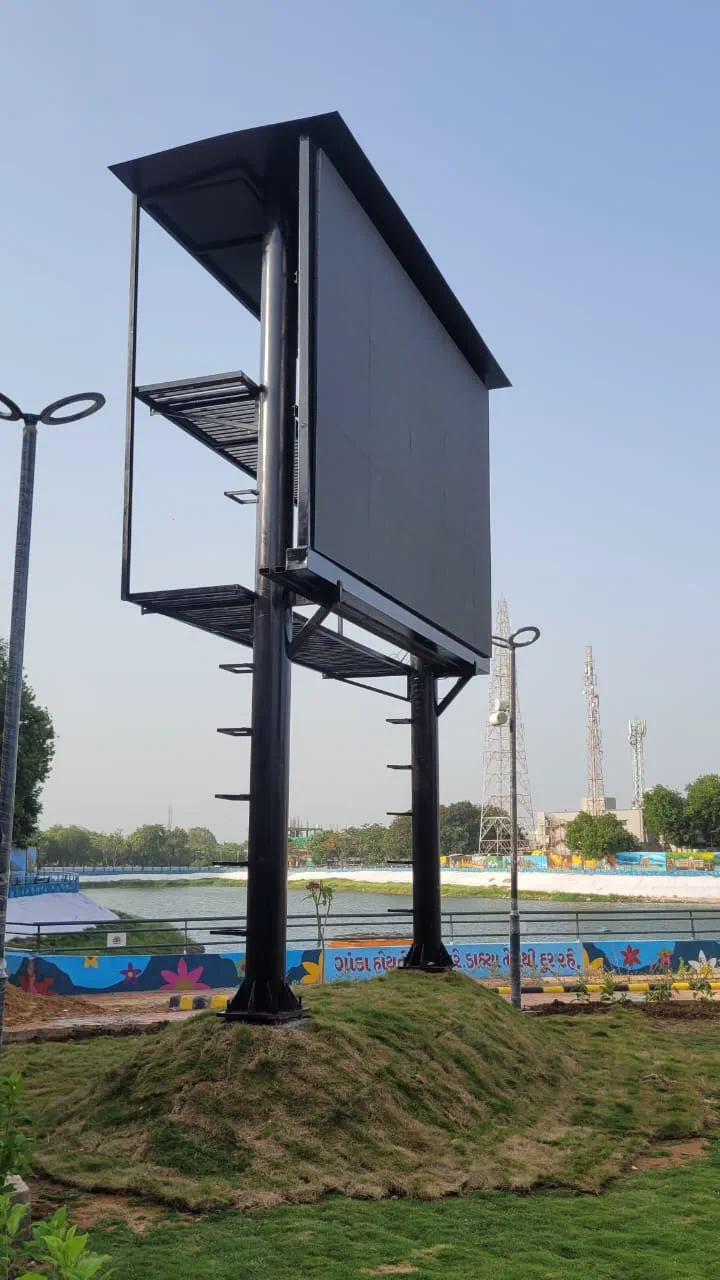
Decide service access at the same stage. A rear-service screen needs a catwalk or corridor behind it; a front-service screen can sit flush to a wall. See front-service vs rear-service cabinets.
Why outdoor LED displays can cost less per sq ft
Outdoor panels need more brightness and sealing, yet a square foot of outdoor screen can cost less than indoor, because the gap comes from pitch. Pixels per sq ft follow the square of the pitch: about 929 at P10 against about 41,290 at P1.5, some 44 times as many.
Pitch for pitch, outdoor costs more, and outdoor jobs also carry a structure. The price for your screen depends on your requirement, so we quote it once we know the size, pitch and site. Our LED screen guide explains what decides the cost.
Can I use an indoor screen outdoors?
No. An indoor screen at 600–1,200 nits washes out in direct sun, which needs 5,500–7,000, and falls short even of the 3,500–4,500 a shaded spot needs. It isn’t sealed either: monsoon rain, dust and humidity reach the modules and power supplies, and water and mains-powered electronics are a bad combination.
Under a canopy or behind glass the answer is the same, for brightness if not for rain. An indoor screen bought for an outdoor position isn’t a saving. It is a screen nobody can read in daylight, with weather working its way inside. If budget is the reason for asking, the real saving is an outdoor panel with a coarser pitch matched to your viewing distance.
The reverse works but rarely makes sense. An outdoor screen indoors will run, but you pay for brightness and sealing you’ll never use, at a pitch chosen for longer distances. The exception is a window-facing screen: indoors, but it needs outdoor-rated panels.
Indoor or outdoor: a checklist before you buy
- Note what reaches the screen face: direct sun, shade, rain, dust or salt air.
- If daylight reaches it, through glass or not, specify outdoor-rated panels.
- Match brightness to the light: 600–1,200 nits indoors, 3,500–4,500 in shade, 5,500–7,000 in direct sun.
- Anywhere weather can reach, ask for IP65 on the front and the rear.
- Choose pitch from your nearest regular viewer’s distance, not from the brochure.
- Outdoors, ask who designs the structure, to what wind load, and how service access works.
- Confirm that brightness can be scheduled down after dark.
- Compare per-sq-ft prices only when pitch, brightness and sealing match.
Questions buyers ask
Can I use an indoor LED screen outdoors?
No. Indoor screens run at 600–1,200 nits, while a screen in direct sun needs 5,500–7,000 nits and even a shaded outdoor spot needs 3,500–4,500. Indoor screens also aren’t sealed, so monsoon rain, dust and humidity reach the modules and power supplies. Outdoors, specify outdoor-rated panels with IP65 on the front and the rear.
Do I need an outdoor LED screen if it’s behind my shop window?
Yes, for brightness. A screen behind glass stays dry, but it faces daylight from the street, and indoor panels at 600–1,200 nits wash out behind glass in direct sun. Storefront and window-facing installations should use outdoor-rated panels, with brightness matched to the sun on the screen face: 5,500–7,000 nits for direct sun, 3,500–4,500 for shade.
What IP rating does an outdoor LED display need in Gujarat?
For Gujarat’s monsoon and dust, NexGlow recommends IP65 on the front face and the rear. IP65 means dust-tight and protected against water jets from any direction. Coastal and fully exposed sites, where weather and salt air reach the back too, should be IP65 front and rear.
Why is an outdoor LED display cheaper per sq ft than an indoor one?
Because outdoor screens are read from further away and use coarser pitches, with far fewer pixels per sq ft: about 929 at P10 against about 41,290 at P1.5. Pitch for pitch, outdoor costs more, and outdoor jobs add a structure; the price for a given screen depends on its requirement and is set when it is quoted.
How bright should an LED screen under a canopy or covered walkway be?
Shaded outdoor positions and covered walkways can use 3,500–4,500 nits, because the roof keeps direct sun off the screen face. If afternoon sun reaches the face, specify 5,500–7,000 nits as for direct sun. A roof doesn’t keep out dust, humidity or wind-driven rain, so the screen still needs outdoor sealing: IP65 front and rear.
Will an outdoor LED screen be too bright at night?
It doesn’t have to be. Outdoor brightness can be scheduled down after dark, and a light sensor can step it down automatically as daylight fades. That saves power and spares neighbours and passing drivers a glaring screen. Confirm the dimming arrangement is part of the quote before you sign, because a screen stuck at daytime brightness is a nuisance every night.
Working out a specification?
Send us the wall or the space, how far away people will be and what you need on screen. You get a fixed, all-inclusive quote.
Request a Quote- LED display brightness: how many nits you needAn indoor screen and an outdoor hoarding differ by roughly an order of magnitude in brightness. Getting it wrong is expensive in both directions.
- LED screen guide: how to choose the right displayWe consult and guide you in selecting the ideal LED display for your requirement: pixel pitch by viewing distance, which pitch suits which job, and what decides the cost.