
A screen on a shopfront has a harder job than one inside the shop. It has to work on people who haven’t decided to stop, from riders at a signal to shoppers walking past a row of competing boards. This guide, for shop and showroom owners in Vadodara, Anand and across Gujarat, uses our own installations as the examples.
What is a shopfront LED screen for?
A storefront screen earns its place by doing three things a printed board cannot.
- Being seen from the road. It makes its own light, so with the right brightness it stays readable in afternoon sun and after dark.
- Changing offers without reprinting. A Navratri offer, a new collection or a model launch becomes a file you upload, not a new flex to print and fit.
- Standing out on a busy street. Where every shop has a name board, the screen is the one thing that changes, and movement catches the eye first.
Which LED display formats work for shops and showrooms?
Shopfront screens fall into six formats, and our projects include each of them. Your frontage usually decides between them before your budget does.
Billboards and pole-mounted screens
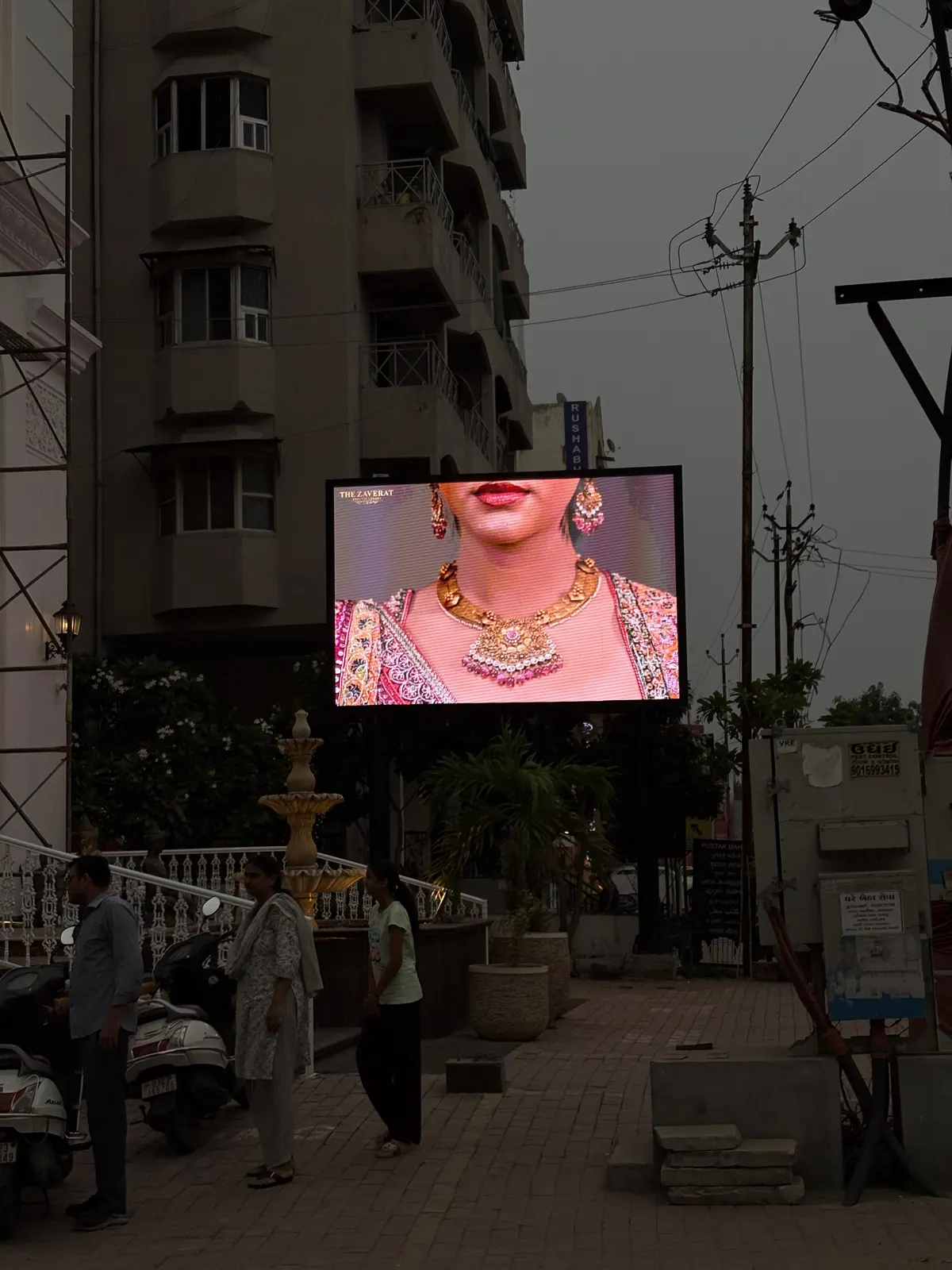
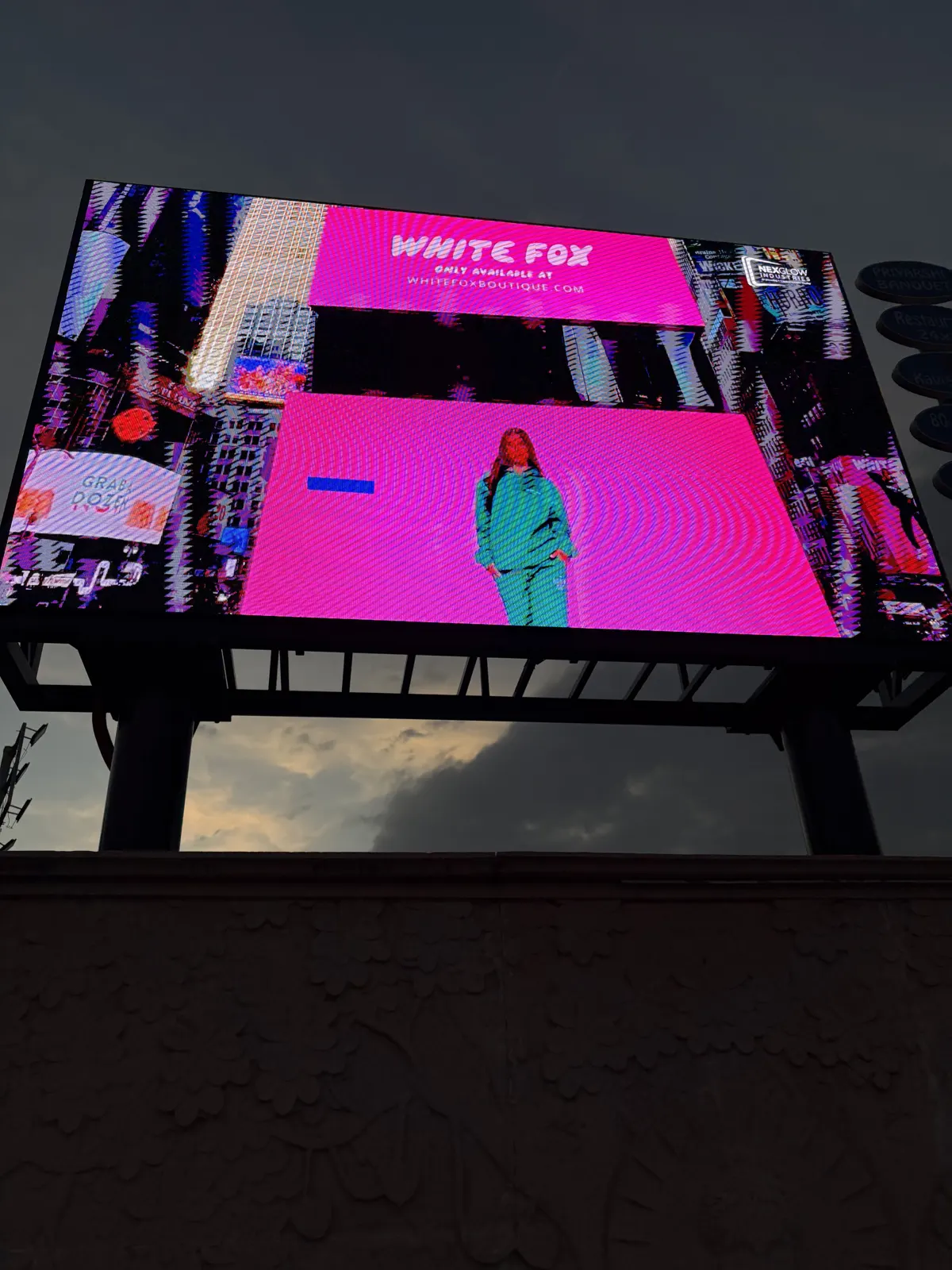
A billboard-format screen stands on its own structure and is read from moving traffic, so a coarse pitch is the right choice and the structure matters as much as the screen. The Zaverat, a jeweller in Anand, has a 14.7 × 9.45 ft outdoor LED billboard. Manish Aura Grand has a pole-mounted one of the same size at its entry gate on the Vadodara Bypass.
Billboard-format screens
Facade displays
A facade display is fixed to the face of the building and becomes part of the shopfront. Shree Janmangal Jewellers in Anand has a 9.45 × 8.4 ft facade LED display. At Atmia Education on the Anand–Vidyanagar Road, a 13.65 × 7.88 ft LED wall sits within a 31 × 11.34 ft facade sign.
A screen inside a larger sign lets the fixed part carry your name while the screen carries what changes. If the screen sits flush on the wall, specify front-service cabinets, so modules come out from the face with magnetic tools.
Long strips over the shopfront
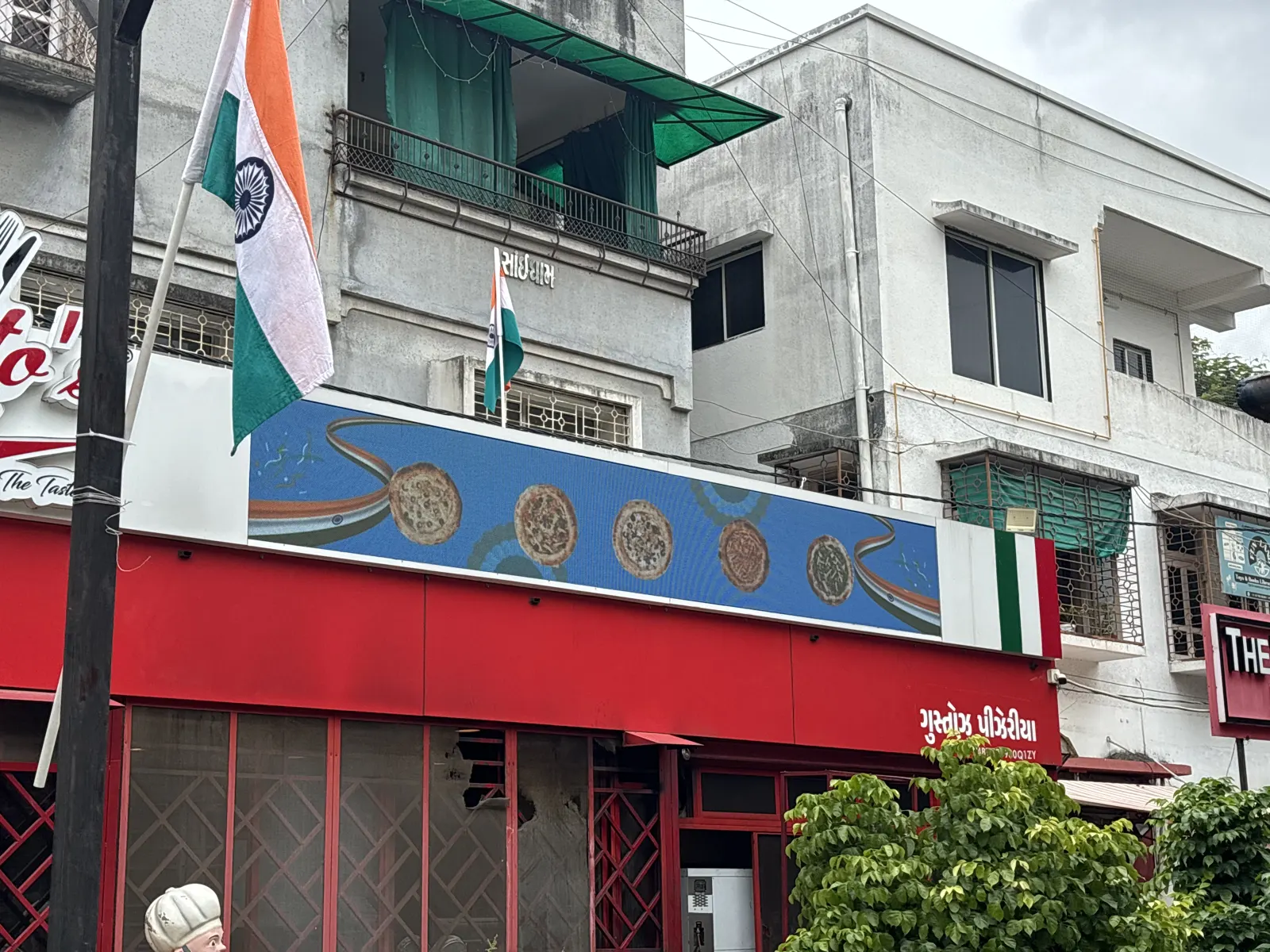
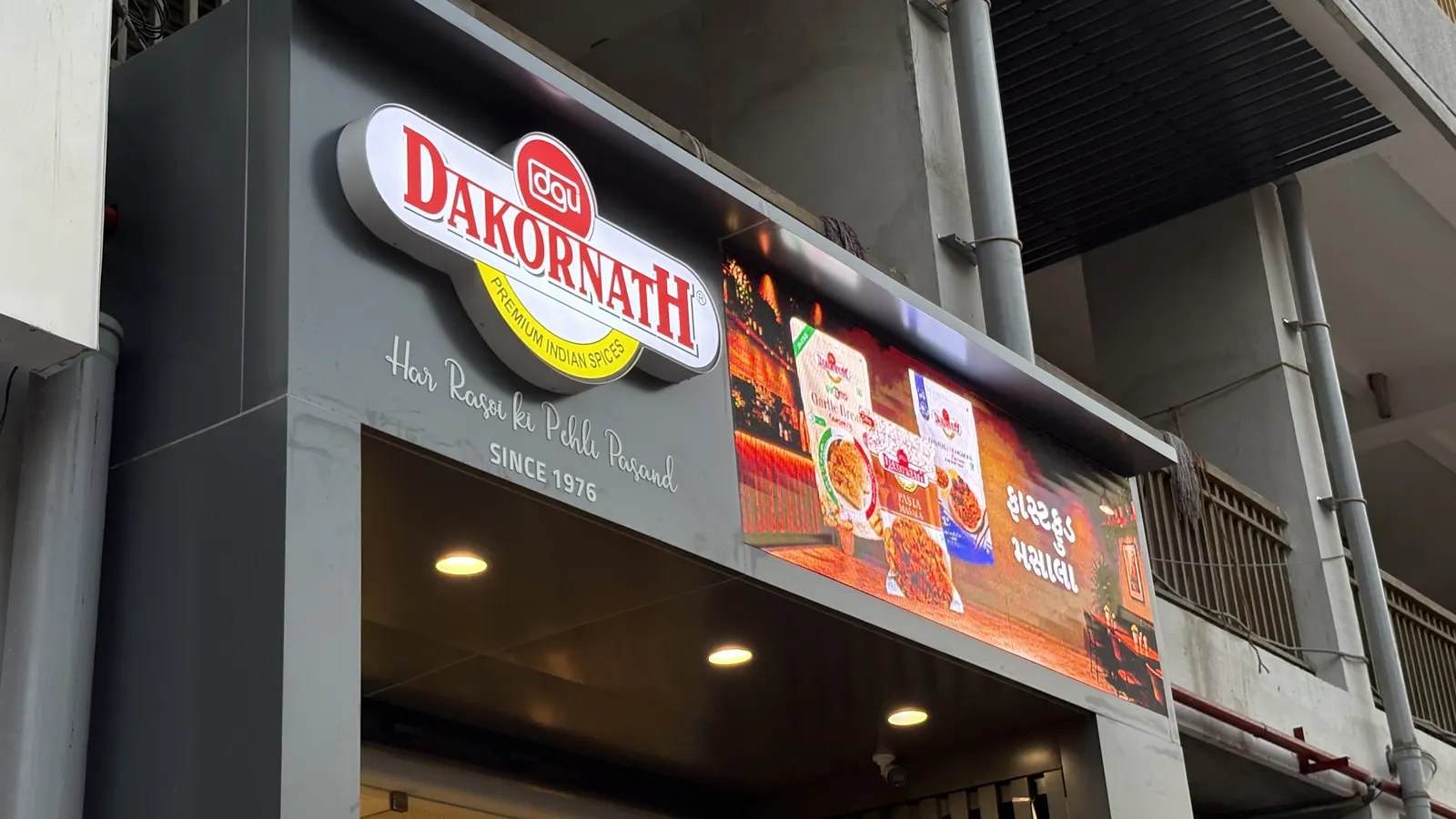
Where the frontage is wide but the band above the shutter is shallow, a long, low strip fits. Gusto’s Pizzeria at Ellora Park, Vadodara, has an 18.89 × 2.62 ft storefront strip; Dakornath Masala at Darbar Chowkdi, Manjalpur, has a 7.35 × 2.62 ft one.
Gusto’s strip is about seven times as wide as it is tall, so a standard 16:9 video can’t fill it without shrinking or cropping. Have content made to the strip’s exact dimensions.
Storefront strips
Vertical screens beside the entrance
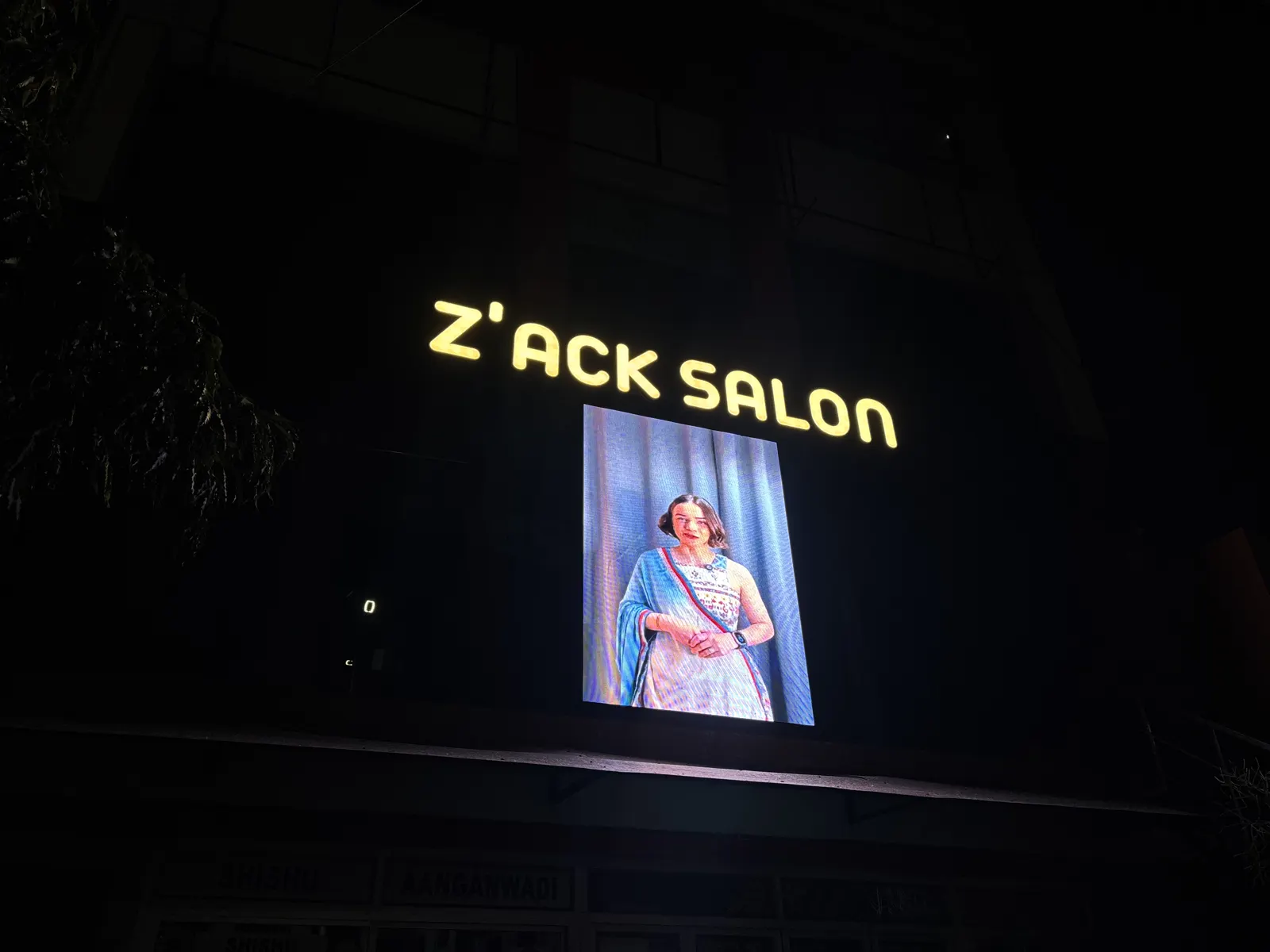
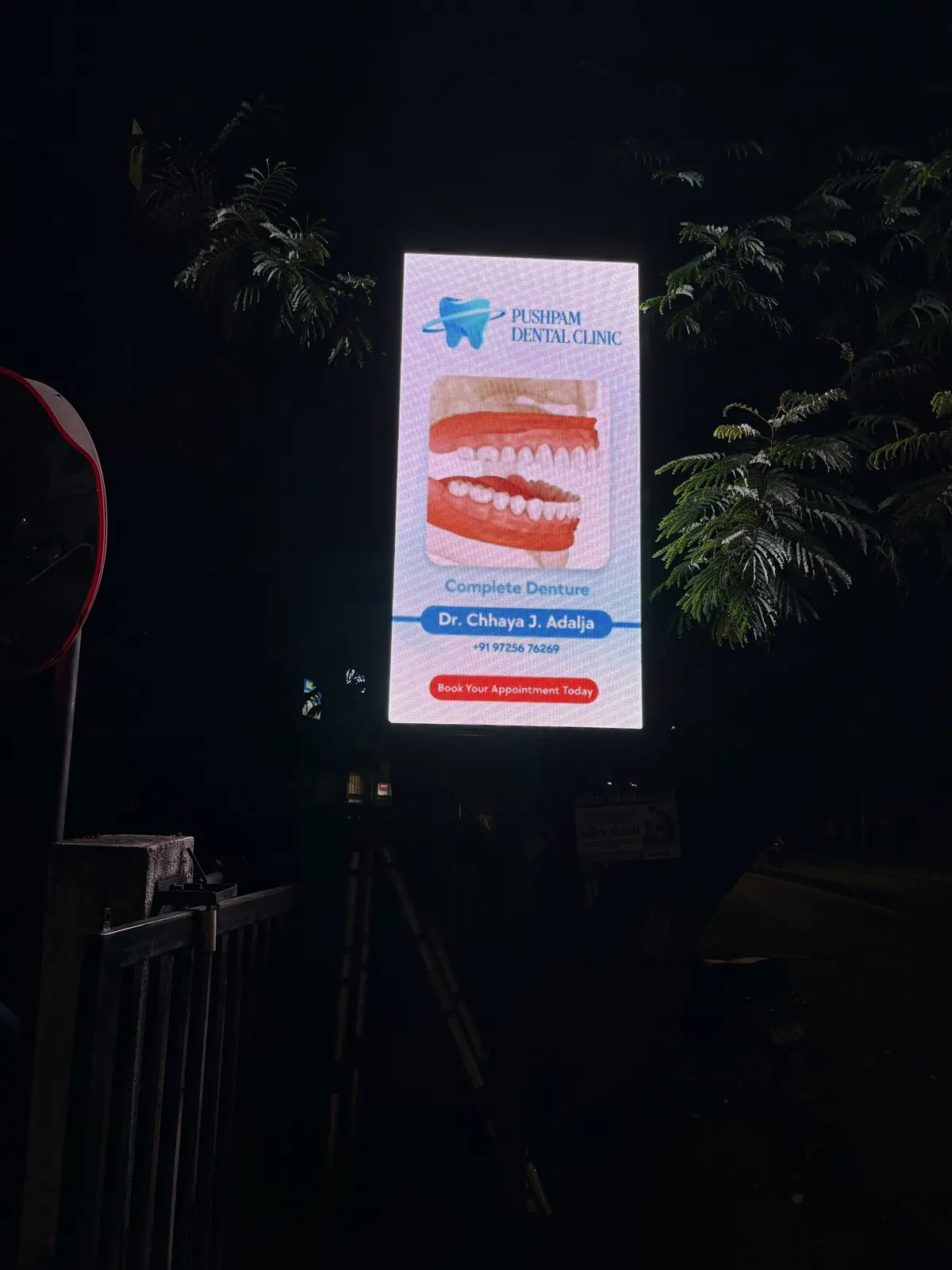
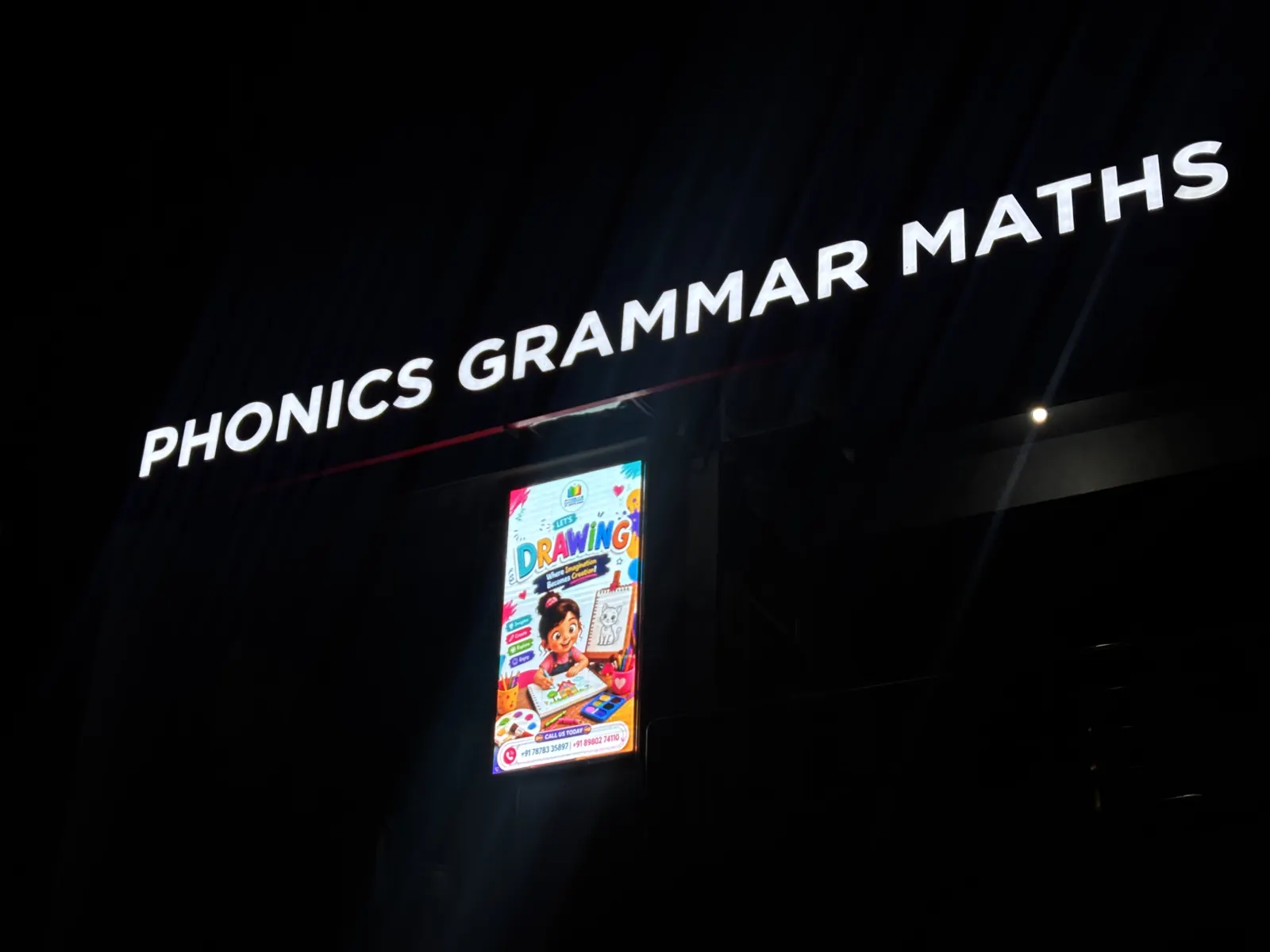
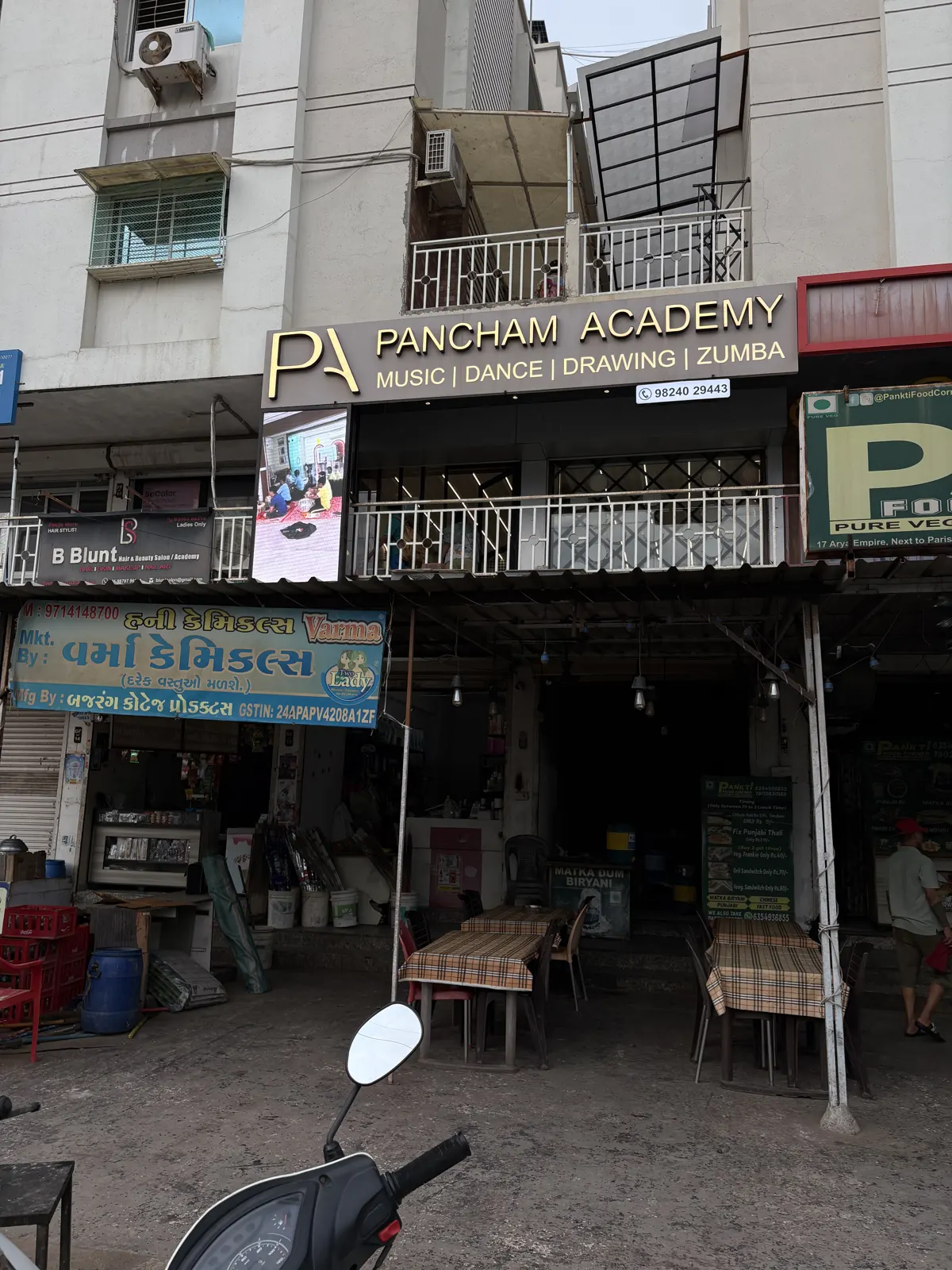
A vertical screen stands beside a door or on a pillar, seen at close range from the footpath. Pushpam Dental on Akota Stadium Road, Phonics by Arpita Shah on Waghodia Road and Pancham Music Academy in Atladara each have a 3.15 × 6.3 ft vertical display; Z’ack Salon in Akota has a 5.24 × 7.35 ft one.
Portrait screens suit the vertical posters and short videos many businesses already make for Instagram. Seen from a few metres away, they are where a finer pitch earns its cost.
Vertical and portrait screens
Car showroom displays
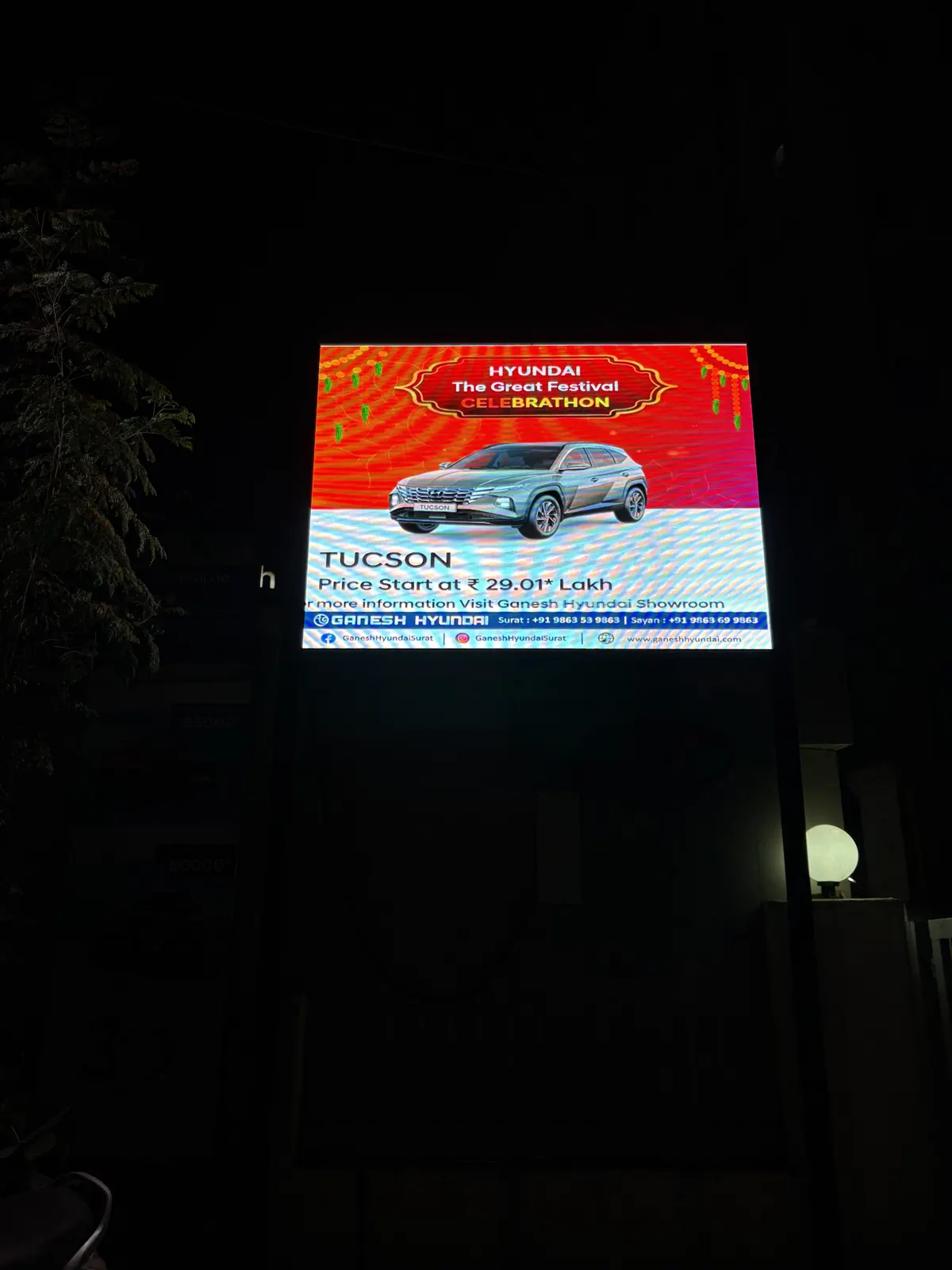
We installed an 8.4 × 6.3 ft outdoor LED at Ganesh Hyundai’s showroom on Makarpura Road, Maneja, and another of the same size at its Gotri Road showroom in Vadodara. In a car showroom the glass frontage and the cars behind it are already the display, so the screen carries what changes: a launch, an exchange offer, a finance scheme.
Matching sizes across branches pays off. If the pitch matches too, one set of content files fits every screen.
Menu screens, outside or in
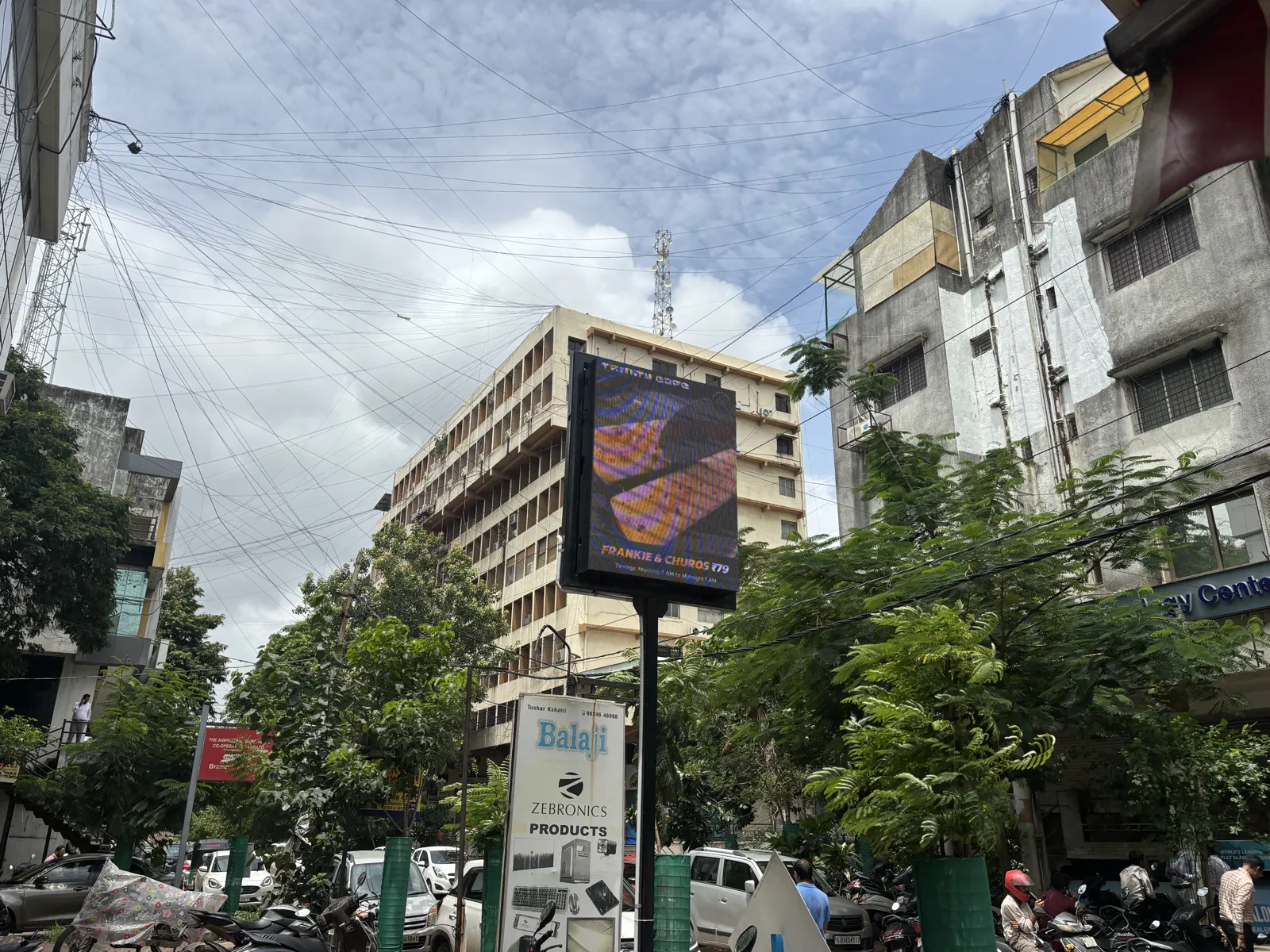
A menu can work from the street as well as the counter. Trinity Cafe in Alkapuri, Vadodara, runs its menu on an LED screen on a pole outside the café, where people passing can read it. Facing the street, that is an outdoor screen, with outdoor brightness and sealing. A menu board inside, at the counter, competes with ceiling lights instead, so indoor panels at 600–1,200 nits suit it; for menus read from a queue at 2–4 m, our guidance is P1.5–P2.5.
Which format suits your frontage?
| Format | Size on our projects | Where it works | What to check |
|---|---|---|---|
| Billboard or pole-mounted | 14.7 × 9.45 ft (The Zaverat, Manish Aura Grand) | Highways, bypasses, arterial roads | Structure, foundations, service access |
| Facade | 9.45 × 8.4 ft (Shree Janmangal Jewellers); 13.65 × 7.88 ft (Atmia Education) | Large wall over or beside the entrance | Front-service cabinets if flush to the wall |
| Storefront strip | 18.89 × 2.62 ft (Gusto’s Pizzeria); 7.35 × 2.62 ft (Dakornath Masala) | Wide frontage, shallow band above the shutter | Content made for a long, low shape |
| Vertical | 3.15 × 6.3 ft (Pushpam Dental, Phonics, Pancham Music Academy); 5.24 × 7.35 ft (Z’ack Salon) | Beside the entrance, read from the footpath | Finer pitch for close viewing |
| Car showroom | 8.4 × 6.3 ft (Ganesh Hyundai, Maneja and Gotri) | Glass-fronted showrooms on main roads | Outdoor brightness; same size and pitch across branches |
| Menu screen | On a pole outside the café (Trinity Cafe) | Cafés and food brands on busy streets; or at the counter inside | Outdoor-rated if it faces the street; indoor panels at the counter |
How big should a shop front LED board be, and where should it go?
Start outside. Stand where customers first see the shop, such as across the road or at the nearest signal, and note what blocks the view: trees, electric poles, a neighbour’s board, parked vehicles. That decides how high the screen must sit.
Then measure how far away those customers are, because distance decides pixel pitch. The minimum comfortable viewing distance in metres is roughly the pitch in millimetres, so P4 looks continuous from about 4 m. For shopfronts we suggest P2.5–P4 read from across a footpath, P4–P6 from across a street and P6–P10 for highway and arterial-road positions; our LED screen guide has the detail.
Where each pixel pitch starts to look like a picture
- P1.5Under 2 m: lobbies, control rooms, close menu boardsfrom ~1.5 m
- P2.52 m and beyond: retail interiors, conference rooms, menu boards, hallsfrom ~2.5 m
- P44–8 m: high-street frontsfrom ~4 m
- P68 m+: storefronts read from across a streetfrom ~6 m
- P10Highway and arterial-road sitesfrom ~10 m
Minimum comfortable viewing distancePixels visibleReads as a continuous image
Size follows from distance: the farther away customers are, the larger the text and the screen. None of the screen sizes in this guide is a round number of feet, because each is a whole number of standard modules, most commonly 320 × 160 mm: 3.15 ft is 960 mm and 14.7 ft is 4,480 mm. A screen can be any size built from whole modules, so measure the space and let your supplier fit the nearest module grid inside it.
How bright does a storefront screen need to be in Gujarat?
The brightness a storefront screen needs depends on how much sun it takes. In direct sun it needs 5,500–7,000 nits to stay readable in peak afternoon glare; a shaded frontage or covered walkway can use 3,500–4,500 nits. Our outdoor panels run at 4,500–7,000 nits, and brightness can be scheduled down after dark.
Check which way the frontage faces. A west-facing shop takes the afternoon sun head-on, while one under a deep chajja may never see it. Our guide to LED brightness explains the numbers.
For Gujarat’s monsoon and dust we recommend IP65 on the front face and the rear. IP65 means dust-tight and protected against water jets.
Do you need permission for an outdoor LED sign?
Find out before you order, not after the structure goes up. Outdoor signs and illuminated displays can come under local municipal rules, which differ from town to town, so ask your municipal body if the sign needs permission and what conditions apply.
If you rent, get written consent from the landlord or society for anything fixed to the building. A screen can be moved later; a foundation can’t.
What content works on a shopfront screen?
Shopfront content has to work in the few seconds a passer-by gives it.
- One message per slide, in a few words. If it needs a second sentence, it needs a second slide.
- Large type, strong contrast. Black LED pixels are switched off, so light text on a dark background is easier on the eye after dark and draws less power than a white frame.
- Made at the screen’s resolution. Pixels across equals width divided by pitch: a 1,920 mm-wide screen is 480 pixels across at P4 and 192 at P10. A poster made for a phone gets shrunk to fit, and small text disappears.
- Changed often. A slide left up for months is as easy to ignore as a faded flex. Plan around Uttarayan, Navratri, Diwali, the wedding season and new stock.
- Calm movement. Slow transitions read better than rapid flashing, especially facing a road.
- Someone in charge of it. Decide early who updates the screen and how files reach it: USB, Wi-Fi or a cloud platform.
What does a shop LED display cost?
It depends on your requirement. A shop screen is priced on its display area, and the pitch, brightness and mounting set how much each square foot costs; outdoor structures, which we engineer and install in-house, are part of the job. We look at the frontage, the road and where customers stand, then quote the screen that fits.
Our LED screen guide covers what moves the number.
Our quotes are fixed and all-inclusive (display, structure, installation and warranty). Every installation carries a 1 to 3 year warranty (AMC packages available), with on-site technician visits within 48 hours for critical issues, stocked spare modules for the most-deployed panel types and remote diagnostics on cloud-managed panels.
Before you order: a checklist
- Measure the distance from where customers first see the shop, and note what blocks the view.
- Match the format to the frontage, and the pitch to that distance.
- Check the sun on the frontage: 5,500–7,000 nits for direct sun, 3,500–4,500 if shaded, and outdoor-rated panels for any screen facing the street through glass.
- Confirm IP65 on the front and the rear.
- Confirm front-service cabinets if the screen sits flush on a wall.
- Check municipal rules and landlord or society consent before ordering.
- Plan the first month of content, and who will update it.
- Get a fixed, all-inclusive quote that names size, pitch, brightness, structure, installation and warranty.
For screens in and around Vadodara, see our LED display Vadodara page. For the full range for shops, see our retail display solutions.
Questions buyers ask
What size LED screen do I need for my shop front?
It depends on your frontage and how far away customers are: the farther the viewer, the larger the text and the screen need to be. LED screens are built from whole modules, commonly 320 × 160 mm, so sizes come in steps such as 3.15, 6.3, 8.4 or 9.45 ft. NexGlow’s installations include a 7.35 × 2.62 ft storefront strip, 3.15 × 6.3 ft vertical screens and 14.7 × 9.45 ft billboards.
Can I use an indoor LED screen in my shop window facing the road?
It is the wrong panel for that position. Indoor panels run at 600–1,200 nits and wash out behind glass in direct sun. Storefront and window-facing screens should use outdoor-rated panels: NexGlow’s outdoor panels run at 4,500–7,000 nits, and a screen in direct sun needs 5,500–7,000 nits to stay readable in peak Indian afternoon glare.
Which pixel pitch should I choose for a shop LED board?
Choose pitch by viewing distance. A rough rule is that the minimum comfortable viewing distance in metres equals the pitch in millimetres, so P4 looks continuous from about 4 m. For shopfronts, NexGlow’s guidance is P2.5–P4 for high-street sites read from across a footpath, P4–P6 for storefront windows read from across a street, and P6–P10 for highway and arterial-road positions.
How much does an LED display for a shop cost in Gujarat?
The price depends on your requirement: the size, pixel pitch, indoor or outdoor rating, brightness, mounting and the site itself. NexGlow quotes each job once it knows the requirement, with one fixed, all-inclusive price. Quotes are fixed and all-inclusive, covering display, structure, installation and warranty.
Will an outdoor LED screen cope with the monsoon?
That depends on how it is sealed. For Gujarat’s monsoon and dust, NexGlow recommends IP65 on the front face and the rear: dust-tight and protected against water jets. Every NexGlow installation carries a 1 to 3 year warranty (AMC packages available), with on-site technician visits within 48 hours for critical issues.
Do I need permission to put an LED screen outside my shop?
Possibly, so check before you order. Outdoor signs and illuminated displays can come under local municipal rules, which differ from town to town. Ask your local municipal body whether the sign needs permission and whether there are conditions on size, height, position or night-time brightness. If you rent the premises, also get written consent from the landlord or society for anything fixed to the building.
Working out a specification?
Send us the wall or the space, how far away people will be and what you need on screen. You get a fixed, all-inclusive quote.
Request a Quote- Indoor vs outdoor LED displays: what actually changesBrightness, weather sealing, pixel pitch, structure and cost: what separates an indoor LED screen from an outdoor one, and how to treat shop windows and covered walkways.
- What to ask for in an LED display quoteTwo quotes for the same wall can differ enormously and both be honest. Usually they are not quoting the same scope.